Because of Winn-Dixie Reading Level: 670L, AR 3.9, Guided Reading R
Because of Winn-Dixie by Kate DiCamillo is Lexile 670L, AR level 3.9 with 3 AR points, Guided Reading R and DRA 40. It is short for a class novel, the words are mostly everyday ones, and the audiobook runs just under three hours.

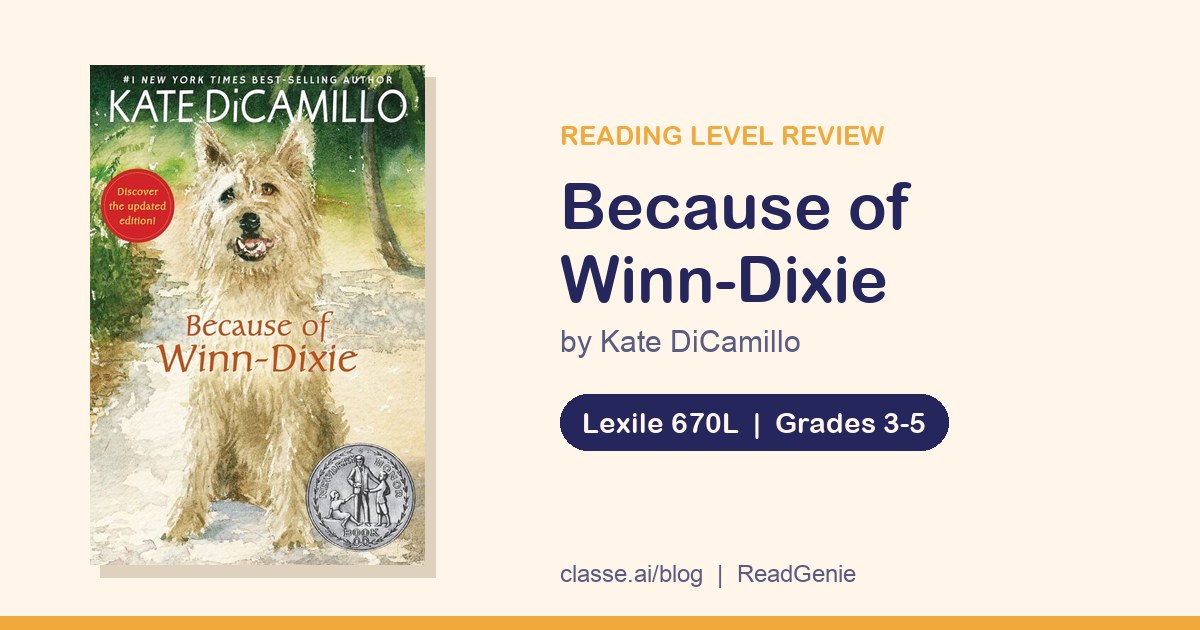
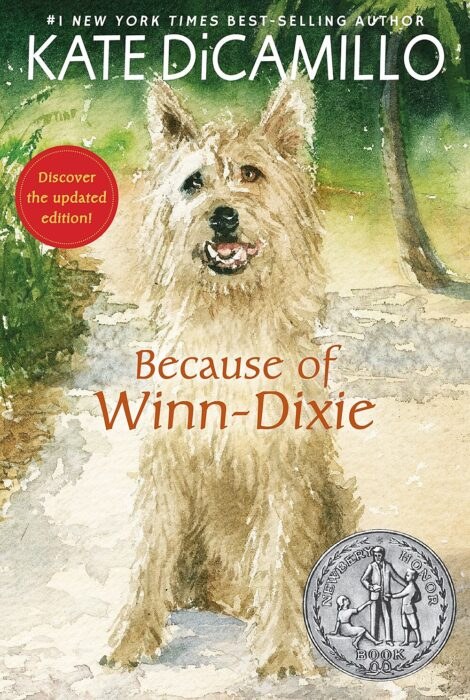
Because of Winn-Dixie by Kate DiCamillo has a Lexile measure of 670L, an AR (ATOS) book level of 3.9 worth 3 AR points, Guided Reading level R and DRA 40, so most children can read it on their own somewhere in grades 3 to 5. It is short for a class novel, about 22,000 words in 26 brief chapters, told in a warm, funny voice with mostly everyday words. That makes it one of the best first full-length novels for a struggling reader in 4th or 5th grade, especially with the audiobook nearby for the longer sentences.
Ten-year-old Opal has just moved to a small Florida town with her father, a quiet preacher, and she doesn't know anyone. She goes to the Winn-Dixie grocery store for macaroni and cheese and comes home with a huge, scruffy stray who grins so wide he sneezes. She names him after the store. Because of that dog, Opal starts making friends with the town's lonely and left-out people, and she finally works up the nerve to ask her father about the mother who left. Kids love the dog, the jokes, and the feeling that Opal is talking straight to them.
Because of Winn-Dixie reading level at a glance
| Lexile measure | 670L (Penguin Random House) Also listed as 660L |
|---|---|
| ATOS / AR book level | 3.9 (TeachingBooks) |
| AR points | 3 (TeachingBooks) |
| Guided Reading (Fountas & Pinnell) | R (Penguin Random House) |
| DRA level | 40 (Scholastic) |
| Flesch Reading Ease (0-100) | 89.5 ReadGenie estimate |
| Flesch-Kincaid grade | 3.8 ReadGenie estimate |
| Interest level | Grades 4-7 (Penguin Random House) Also listed as Grades 4-8 and Grades 3-8 |
| Approximate grade band | Grades 3-5 (ages 8-11) ReadGenie |
| Length | 192 pages, ~22,123 words |
| Format | Middle grade novel |
| Good for struggling readers? | ★★★★★ 4/5 |
| Dyslexia-friendly rating | ★★★★★ 4/5 |
We couldn't find a published grade level equivalent for this book.
Is Because of Winn-Dixie a struggle for your child right now? ReadGenie gives struggling readers short daily Orton-Gillingham practice at home, out loud, with help on the exact sound they missed.
Try ReadGenie and get this book freeScores checked 2026-11-24. Different leveling systems don't always agree, so we show each published value with its source and mark our own estimates. Links to every source are under How we rate books.
What grade level is Because of Winn-Dixie?
The reading level sits right around the end of 3rd grade and the start of 4th. Most schools teach it in 3rd, 4th or 5th grade, and the publisher lists it for grades 4 to 7.
An AR level of 3.9 means the text is about as hard as what a typical student reads near the end of 3rd grade. Guided Reading R and DRA 40 both land at about the start of 4th grade on most school leveling charts. The Lexile of 670L fits the same window. All of the main levels agree, which is less common than you might think, so you can trust this one to behave the way the numbers say.
You might also see 660L. That number comes from a 2016 chapter-by-chapter guide by MetaMetrics, the company behind the Lexile, made before Candlewick released the updated 20th anniversary edition. The publisher, Scholastic and school catalogs all list 670L for the current edition. Ten points is a rounding difference, not a different book.
Our own readability check on chapter 1 came out at about a 4th grade level, with sentences averaging around 12 words. That matches the official levels. The book reads easily sentence by sentence, but it has no pictures and runs 192 pages, so a child needs some stamina to finish it.
Is Because of Winn-Dixie good for struggling readers?
Yes. We rate it 4 out of 5 for struggling readers, and it is one of the first novels we would hand a 4th or 5th grader who is reading a year behind.
Length is the first reason. At about 22,000 words, it is a third shorter than a lot of the books assigned in the same grades. The 26 chapters average about 850 words, so a slower reader can finish one in under ten minutes and feel done for the night. That rhythm matters for a kid who has learned to dread long books.
The vocabulary helps too. Only about 4 percent of the words in chapter 1 have three or more syllables, and most of the book is plain talk between people. The story opens with a dog wrecking the produce section of a grocery store, which gets reluctant readers laughing before they notice they are reading a real novel. It also doesn't look young. Older kids see classmates reading it and the publisher's interest level runs through 7th grade.
A few things can slow a child down.
- No pictures, so all the meaning has to come from the words
- The very first sentence is long, a whole shopping list strung together, and a few more like it show up later
- The cast is big and the names are unusual (Gloria Dump, Miss Franny Block, Sweetie Pie, Otis)
- The middle of the book is quieter, built on characters telling Opal their stories
A 4th or 5th grader reading about a year behind should do well with an adult reading chapter 1 alongside. A child reading at a 2nd grade level on their own will find it a stretch. Start with Mercy Watson to the Rescue, by the same author, and come back to this one.
Is Because of Winn-Dixie good for kids with dyslexia?
Overall: ★★★★★ 4/5
| Factor | Score | Why |
|---|---|---|
| Sentence length | 3/5 | About 12 words per sentence in chapter 1, with a mix of short lines of dialogue and a few long, comma-joined sentences. |
| Vocabulary load | 4/5 | Mostly everyday words, about 4 percent with three or more syllables. A few longer words (immediately, vegetables, department) and some regional ones. |
| Decodability | 4/5 | Most words follow common patterns. The character names (India Opal Buloni, Winn-Dixie, Gloria Dump, Littmus) are the hardest words to decode. |
| Text density and layout | 3/5 | Standard novel pages in a serif font, with plenty of dialogue breaking up the paragraphs. |
| Pictures that carry meaning | 1/5 | No illustrations in the standard edition. |
| Chapter length | 4/5 | 26 chapters averaging about 850 words, roughly 8 minutes each for a slower reader. |
| Engagement for reluctant readers | 4/5 | Funny dog scenes and a warm narrator, though the middle of the book is quieter and built on characters' stories. |
| Audiobook / read-along support | 5/5 | Unabridged Listening Library audiobook read by Jenna Lamia (2021, 2 hours 56 minutes), widely available through libraries. |
Factor mean 3.5, rounded up: the short chapters, plain words and strong audiobook outweigh the lack of pictures.
We rate Because of Winn-Dixie 4 out of 5 for dyslexic readers. Short chapters, plain words and a strong audiobook carry it. The lack of pictures and a few long sentences hold it back.
Sentence length is mixed. Lots of lines are short bits of dialogue, which are easy to track. Then Opal will get going and string several ideas together with commas and the word and, the way a ten-year-old tells a story. A dyslexic reader who is spending effort on each word can lose the thread by the end of those. Reading them aloud helps, because they sound natural even when they look long.
The words themselves are friendly. Most are short, common and regular. The hardest words to decode are the names, starting with Opal's full name, India Opal Buloni, on the first page. A few grocery store words like produce and aisle trip kids up because they don't sound the way they look.
The pages are standard novel pages in a serif font, but the frequent dialogue breaks up the text and leaves white space. There are no illustrations. Chapters are the book's biggest strength for dyslexic readers, since almost every one is a single short scene.
Audio support is excellent. Listening Library's unabridged audiobook of the updated edition is read by Jenna Lamia and runs 2 hours and 56 minutes, short enough to finish in a week of car rides. Following the print while listening lets a dyslexic child keep up with a class reading schedule without spending every bit of energy on decoding.
Words and phonics patterns to practice first
Chapter 1 is a good sample of the whole book, and almost every word in it follows a pattern a child can learn. A reader who is comfortable with suffixes and vowel teams will move through it much faster.
Past tense -ed shows up constantly, and it makes three sounds. Looked ends in a t sound, smiled and pulled end in a d sound, and started adds a whole syllable. Skidded and wagged are good examples of doubling the last consonant before the ending. Sort a handful into three piles before you read.
The -ing ending is everywhere in the grocery store chaos: running, wagging, rolling, standing, screaming, smiling. Point out which ones double the consonant (running, wagging) and which don't (standing, rolling).
Silent e words like like, store, name, came, face and whole are common. So are r-controlled vowels in words like manager, store, hard, started, first and arms. Vowel teams appear in green, teeth, tail, real, pound and floor, and the digraphs sh, ch, th and wh show up in that, whole, cheese, teeth, white and preacher.
Pre-teach these as whole words before chapter 1: India, Opal, Buloni, Winn-Dixie, Gloria, Littmus, Franny, Naomi, preacher, produce, aisle, immediately, vegetables and employees. If -ed endings and vowel teams are still shaky, short daily Orton-Gillingham practice on those patterns, like the lessons ReadGenie gives at home, makes the first chapters go much more smoothly.
How to read Because of Winn-Dixie with your child
Read chapter 1 aloud together. The grocery store scene is funny out loud, and once your child is invested in the dog, they will want to keep going.
Practice the names before you start. Say India Opal Buloni, Winn-Dixie, Gloria Dump and Miss Franny Block a few times together. Kids who stumble on a name every page get tired fast, and this book has a lot of them.
Two short chapters a night finishes the book in about two weeks. On harder days, let your child read the first page of a chapter and listen to the rest on the audiobook.
Keep track of Opal's friends as you go. A simple list on the inside cover, with one thing about each person, helps a child hold the cast in their head.
Save the 2005 movie for after the book. Watching it together and talking about what changed is a fun reward for finishing.
Using Because of Winn-Dixie in the classroom or tutoring
For teachers, this is one of the most common 3rd to 5th grade class novels, and it fits a three-week unit at about two chapters a day. Chapter 1 is a natural lesson on first person point of view, since Opal tells the whole story and talks directly to the reader. DiCamillo's similes are another good thread, and the Candlewick teachers' guide suggests having students collect them in a journal as they read. Students who need it can listen to the audiobook for homework chapters and still join the discussion.
For tutors, preview India, Opal, Buloni, Winn-Dixie, Gloria, Littmus and aisle before the first session. Chapter 1 gives plenty of -ed and -ing practice (looked, smiled, skidded, wagged, running, wagging). One activity works well with this book. Take the long opening sentence and have your student break it into two or three shorter ones, then read DiCamillo's version again aloud. It builds sentence sense and expression at the same time.
Content notes for parents
This is a gentle book, but it is not all sunshine. Opal's mother left when Opal was very young, and her father eventually tells her that she drank too much. Several adults Opal befriends have hard pasts. Otis spent time in jail, and Gloria Dump keeps empty bottles tied to a tree from the years she drank. A friend's little brother drowned the year before, which comes up in conversation. The librarian tells a Civil War story in which a family dies of illness and battle, and slavery is mentioned. One boy uses a slur about Otis. Winn-Dixie panics in thunderstorms and goes missing during one near the end. Most families find it fine for 8 and up, and the hard moments are handled with a lot of kindness.
Should your child read it?
If your child is in 3rd, 4th or 5th grade and reads close to grade level, or is in 4th or 5th grade and reads a year behind, this is an easy yes. It is short, funny and warm, and finishing it gives a struggling reader a real novel to be proud of. Pair it with the audiobook if long sentences are hard. If your child still needs pictures on most pages, read Mercy Watson to the Rescue first, and if they flew through this one, The Tale of Despereaux is a good next step.
Make the next book easier
Short daily sessions of reading, spelling and handwriting practice, built with Orton-Gillingham teachers. It works alongside tutoring and school support. The first 7 days are free. Join today and we'll mail your child Because of Winn-Dixie for free.
Try ReadGenie and get your free bookStarts with a free 7-day trial. Book mailed after your first paid month. US only, one per family.
FAQ
How many AR points is Because of Winn-Dixie?
Because of Winn-Dixie is worth 3 AR points, with an AR (ATOS) book level of 3.9. It is about 22,000 words long, so it earns fewer points than longer novels taught in the same grades.
What is the Because of Winn-Dixie Lexile level?
The publisher, Scholastic and school catalogs list Because of Winn-Dixie at 670L for the current edition. A 2016 MetaMetrics guide made before the updated edition lists 660L. Either way it sits in the 3rd to 4th grade range.
What is the Fountas and Pinnell level for Because of Winn-Dixie?
Because of Winn-Dixie is Guided Reading (Fountas and Pinnell) level R, according to the publisher. Scholastic and Booksource list R too. That level usually lines up with the end of 3rd grade or the start of 4th.
What age range is Because of Winn-Dixie for?
Most kids read it between ages 8 and 11. The publisher lists it for ages 9 to 12, grades 4 to 7. Younger children can enjoy it as a read-aloud.
Is Because of Winn-Dixie appropriate for 3rd grade?
For many 3rd graders, yes. The reading level fits a strong 3rd grade reader, and the content is gentle. A parent may want to talk about Opal's mother, who left because of her drinking, and the friend's brother who drowned.
Is Because of Winn-Dixie appropriate for 2nd grade?
It works well as a read-aloud for 2nd graders. Reading it alone is a stretch for most 2nd graders, since it has no pictures and runs 192 pages. Try Mercy Watson to the Rescue for independent reading first.
Get Because of Winn-Dixie free
ReadGenie helps struggling readers improve their reading, spelling and handwriting in short daily sessions at home. Join and we'll mail your child this book for free.
Claim your free bookStarts with a free 7-day trial. Book mailed after your first paid month. US only, one per family.
What to read next
- Mercy Watson to the Rescue by Kate DiCamillo (easier). A much shorter, illustrated early chapter book by the same author, about a pig who causes chaos.
- Charlotte's Web by E.B. White (similar). Another classic about a girl, an animal friend and a small town, often read in the same grades.
- The One and Only Ivan by Katherine Applegate (similar). An animal story told in very short chapters, with a gentle, hopeful ending.
- The Tale of Despereaux by Kate DiCamillo (harder). DiCamillo's Newbery Medal fairy tale about a brave mouse, longer and with richer vocabulary.
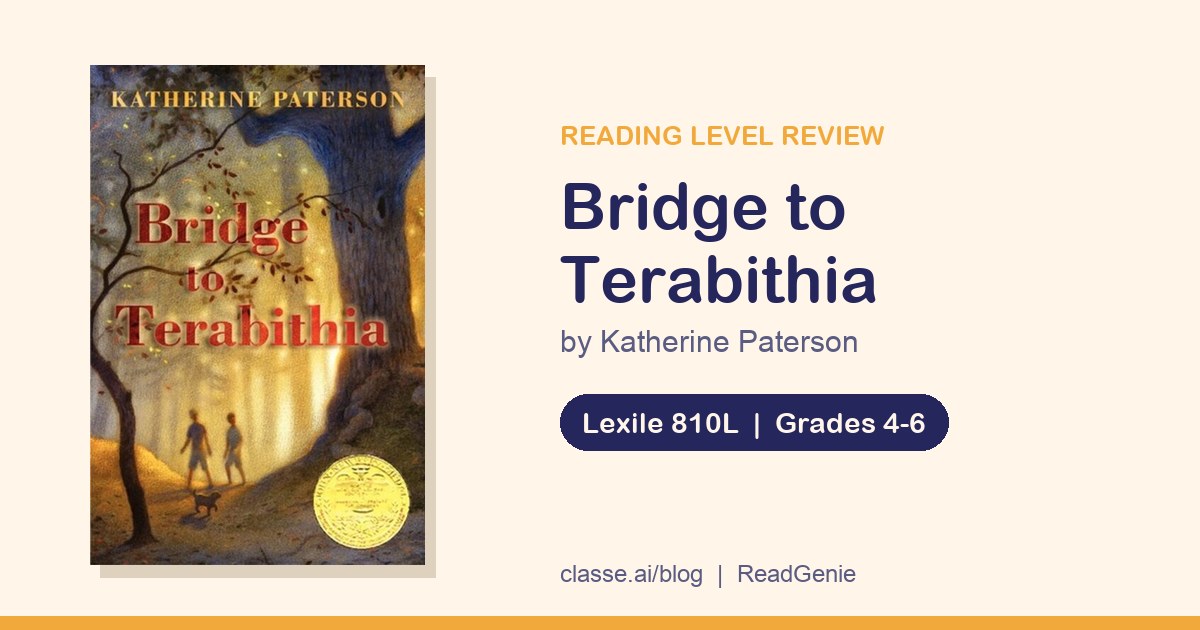
- Bridge to Terabithia by Katherine Paterson (harder). A longer friendship story set in a small town, with a heavier loss at its center.
Browse all of our reading-level book reviews.
How we rate books
Lexile, ATOS (Accelerated Reader), Guided Reading and DRA levels come from the companies that own them and from publishers. We link to where we found each one, and when a level isn't published we say so. Anything marked "ReadGenie estimate" is our own call, not an official level. Flesch scores come from a short public excerpt when the publisher offers one. The struggling-reader and dyslexia-friendly ratings are our judgment, based on eight things (sentence length, vocabulary, decodability, page layout, pictures, chapter length, how gripping the story is, and audiobook support). Treat them as a starting point. The right book is one your child can read with about 95% accuracy and wants to keep reading.
Sources
- Penguin Random House: Because of Winn-Dixie (Candlewick) (Lexile, Guided Reading, interest level, pages, edition, excerpt)
- Scholastic Teacher Store: Because of Winn-Dixie (DRA, ACR, Guided Reading check, Lexile check, pages, grades)
- TeachingBooks: Because of Winn-Dixie (ATOS, AR points, word count, Lexile check, grades)
- Booksource: Because of Winn-Dixie (2021 Candlewick paperback) (edition, pages, Guided Reading check, Lexile check, AR check, interest level)
- MetaMetrics: Lexile by Chapter, Because of Winn-Dixie (Lexile conflict, chapter count, chapter Lexile range)
- Penguin Random House: Because of Winn-Dixie audiobook (Listening Library) (audiobook narrator, edition and length)
- Candlewick Press Teachers' Guide: Because of Winn-Dixie (summary, content notes, teaching ideas)
- Plugged In: Because of Winn-Dixie book review (content notes)