Freak the Mighty Reading Level: Lexile 1000L, AR 5.5, Guided Reading W
Freak the Mighty by Rodman Philbrick is Lexile 1000L by MetaMetrics (930L on Scholastic), AR level 5.5 with 5 AR points, Guided Reading W and DRA 60. The words are mostly short, the narrator is a boy who struggles with reading, and the audiobook runs just over three hours.

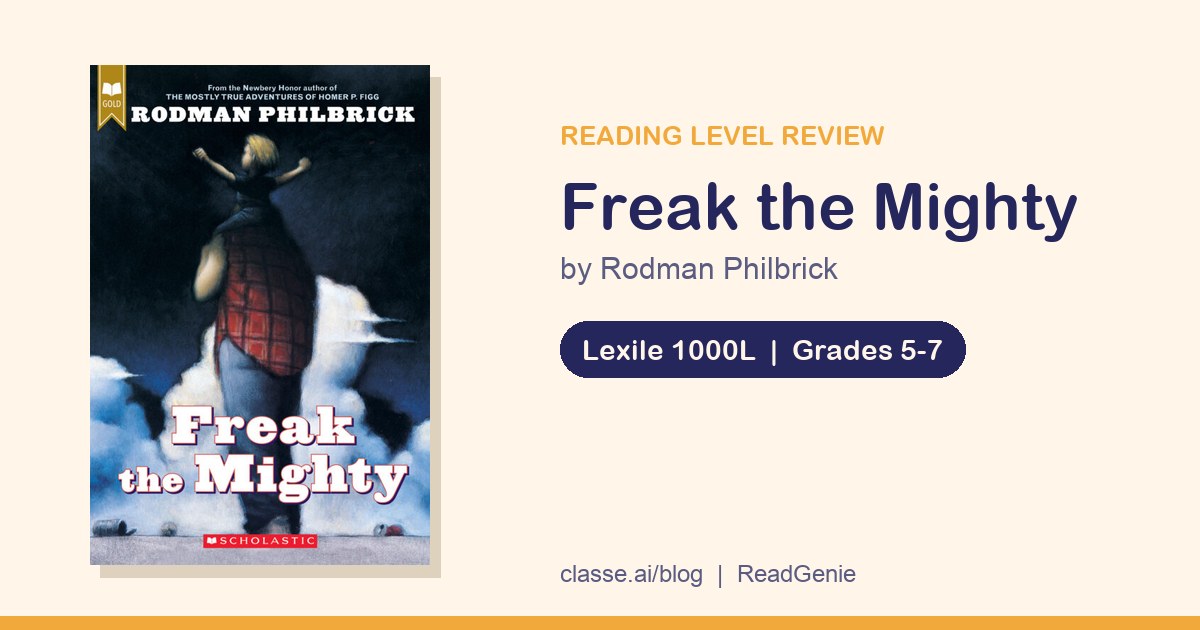
Freak the Mighty by Rodman Philbrick has a Lexile measure of 1000L from MetaMetrics (Scholastic and school catalogs list 930L), an AR (ATOS) book level of 5.5 worth 5 AR points, Guided Reading level W and DRA 60. The words are mostly short and common, and the story is told by Max, an eighth grader who thinks he has no brain and learns to read with his friend's help, so it is a strong pick for a middle schooler who reads below grade level. Max's long, rambling sentences and Freak's showy vocabulary make it harder than its 192 pages suggest, so many struggling readers do best with the audiobook alongside.
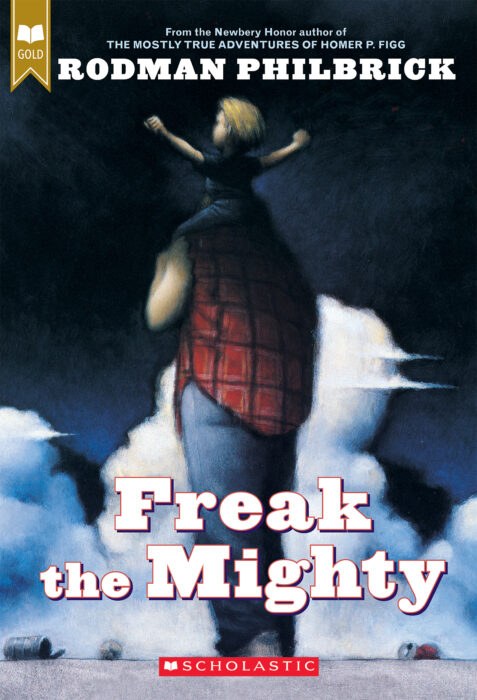
Max Kane is huge for his age and lives in a basement room at his grandparents' house. He is sure he is stupid. Kevin, who everyone calls Freak, is tiny because of a rare condition, walks with braces and crutches, and knows more words than anyone Max has ever met. The summer before eighth grade, Freak climbs up on Max's shoulders and the two of them become Freak the Mighty, half brain and half muscle, out on quests around town. Kids love it because Max talks to the reader like a friend, the friendship feels real, and it is one of the few class novels where the hero is a kid who has trouble at school.
Freak the Mighty reading level at a glance
| Lexile measure | 1000L (MetaMetrics) Also listed as 930L and 930L |
|---|---|
| ATOS / AR book level | 5.5 (TeachingBooks) |
| AR points | 5 (TeachingBooks) |
| Guided Reading (Fountas & Pinnell) | W (Scholastic) |
| DRA level | 60 (Scholastic) |
| Flesch Reading Ease (0-100) | 82.3 ReadGenie estimate |
| Flesch-Kincaid grade | 6.1 ReadGenie estimate |
| Interest level | Grades 7-12 (Scholastic) Also listed as Grades 5-9 and Grades 5-12 |
| Approximate grade band | Grades 5-7 (ages 10-13) ReadGenie |
| Length | 192 pages, ~35,442 words |
| Format | Middle grade novel |
| Good for struggling readers? | ★★★★★ 4/5 |
| Dyslexia-friendly rating | ★★★★★ 3/5 |
We couldn't find a published grade level equivalent for this book.
Is Freak the Mighty a struggle for your child right now? ReadGenie gives struggling readers short daily Orton-Gillingham practice at home, out loud, with help on the exact sound they missed.
Try ReadGenie and get this book freeScores checked 2026-11-23. Different leveling systems don't always agree, so we show each published value with its source and mark our own estimates. Links to every source are under How we rate books.
What grade level is Freak the Mighty?
The words read at about a 5th or 6th grade level. The story is meant for middle school, and most schools teach it in 6th, 7th or 8th grade.
You may see two Lexile numbers for this book, and both are real. MetaMetrics, the company that makes the Lexile, gives it 1000L in its own chapter-by-chapter guide. Scholastic, which publishes the paperback, and the big school catalogs list 930L. Either way it lands in the middle school range, and higher than the AR level would suggest. The reason is Max's voice. He tells the story in long sentences strung together with commas, the way a kid talks when he gets going, and the Lexile formula counts sentence length heavily. The words inside those sentences are mostly easy.
An AR level of 5.5 means the text is about as hard as what a typical student reads in the middle of 5th grade. Our own readability check on the first two chapters came out near a 6th grade level, again because of sentence length rather than vocabulary.
Guided Reading W and DRA 60 both sit around 5th grade on most school leveling charts. Scholastic lists the book for grades 7 to 12, and the author's teaching guide calls it a middle school book. That leaves a useful gap. A 7th or 8th grader reading a year or two behind can read the words, and the story treats them like the teenager they are.
Is Freak the Mighty good for struggling readers?
Yes, for most middle schoolers. We rate it 4 out of 5 for struggling readers.
The biggest reason is Max himself. He starts the book sure that he has no brain, his grandparents worry about him, and over the course of the story a friend teaches him that he can read, write and think. A kid who has spent years in reading intervention will recognize a lot of Max in themselves. That is rare in an assigned novel, and it can change how a reluctant reader feels about the whole thing.
The book is also short for a class novel. It runs about 35,000 words, a third the length of The Maze Runner, in 25 chapters of about 1,400 words each. Only about 4 percent of the words in the opening chapters have three or more syllables. The quests, a run-in with a gang of older boys, and the kidnapping later in the book keep it moving.
A few things trip readers up.
- Max's sentences average about 17 or 18 words, and many run on with comma after comma
- Freak uses big words on purpose, partly to show off, and Max keeps repeating them
- There are no pictures to help with meaning
- The ending is sad, and the switch from funny quests to serious illness surprises some kids
A 6th to 8th grader reading a year or two behind will do well if an adult reads the first chapter with them. A child reading below a 5th grade level on their own should listen to the audiobook while following along, or start with Fish in a Tree.
Is Freak the Mighty good for kids with dyslexia?
Overall: ★★★★★ 3/5
| Factor | Score | Why |
|---|---|---|
| Sentence length | 2/5 | About 17 or 18 words per sentence in the opening chapters, many of them run-ons joined by commas. |
| Vocabulary load | 3/5 | Mostly everyday words, about 4 percent with three or more syllables, but Freak's showpiece words (unvanquished, ornithopter, mastodons) appear often. |
| Decodability | 3/5 | Most words follow common patterns. Max's slang (butthead, earthling) is easy, but names like Gwen and Loretta and Freak's invented words need a preview. |
| Text density and layout | 3/5 | Standard paperback pages in a serif font with fairly long paragraphs. |
| Pictures that carry meaning | 1/5 | No illustrations in the standard edition. |
| Chapter length | 3/5 | 25 chapters averaging about 1,400 words, roughly 10 minutes each for a slower reader. |
| Engagement for reluctant readers | 5/5 | Max's funny, honest voice and the Freak the Mighty quests pull readers in from chapter 1. |
| Audiobook / read-along support | 5/5 | Unabridged audiobook read by Elden Henson, 3 hours 16 minutes, widely available through libraries on OverDrive. |
We rate Freak the Mighty 3 out of 5 for dyslexic readers. Engagement and audio support are excellent. Sentence length, plain pages and no pictures pull the score down.
Sentence length is the hardest part. Max tells the story the way he would talk to you, so one sentence can carry four or five ideas joined by commas. For a dyslexic reader who is spending energy on each word, it is easy to lose track of who did what by the end. Reading those long sentences aloud, or hearing them on the audiobook, helps a lot, because they sound natural even when they look long on the page.
Vocabulary is easier than it first appears. Most words are everyday ones. The hard words come from Freak, who collects them, and Max is often just as puzzled by them as the reader. A child gets to figure them out alongside the narrator.
Decoding is mostly regular. Names like Gwen and Loretta and a handful of Freak's invented words are worth a quick preview. The Scholastic paperback has standard pages of serif type with fairly long paragraphs, and there are no illustrations. The chapters help, since a slower reader can finish most of them in about 10 minutes.
Audio is the best support here. The unabridged audiobook is read by Elden Henson, who played Max in the movie, and runs about 3 hours and 16 minutes. That is short enough to listen to the whole book in a week of car rides, and libraries carry it on OverDrive. Listening while following the print lets a dyslexic student keep up with the class without spending all their energy on decoding.
Words and phonics patterns to practice first
Most of the longer words in Freak the Mighty are built from patterns a child can learn to break apart. A reader who can spot a suffix and split a word into syllables will move through it much faster.
Consonant-le endings show up often in the opening chapters: little, people, ripple, scuttle, angle, handle. Teach that the consonant before -le joins it to make the last syllable (lit-tle, peo-ple, han-dle).
The suffix -tion is in many of Freak's bigger words: invention, attention, observation, motion, installation. Teach that it says "shun" and comes at the end.
Past tense -ed makes three sounds. Talked ends in a t sound, wanted and needed add a syllable, and called and moved end in a d sound. Sort them into three groups.
Compound words are everywhere: something, slingshot, playground, otherwise, sometimes, earthling. Cover one half, read the other, then put them back together.
The suffix -ly carries a lot of Max's storytelling: really, probably, finally, hardly, actually, barely. R-controlled vowels show up in words like under, remember, earth, before, better and care.
Pre-teach these as whole words before chapter 1: Kevin, Maxwell, Gwen, Loretta, Kenny, unvanquished, ornithopter, mechanical, prehistoric, mastodons, microsecond, beautiful, dangerous and persuaded. If suffixes and syllable division are still shaky, short daily Orton-Gillingham practice on multisyllable words, like the lessons ReadGenie gives at home, makes Freak's vocabulary far less of a wall.
How to read Freak the Mighty with your child
Read chapter 1 aloud together. Max's run-on sentences make much more sense once your child hears how he talks, and by the end of the chapter most kids are hooked on his voice.
Start a word list for Freak's big words on a sticky note. When one comes up, look it up together, which is exactly what Max ends up doing in the story. Kids like being let in on the joke.
Two chapters a night finishes the book in about two weeks. If your child is tired, let them read the first page of a chapter aloud and listen to the rest on the audiobook.
Talk about Max as you go. He thinks he is dumb at the start. Ask your child what they notice about how he thinks and solves problems, and whether he is as slow as he believes.
If your child is sensitive, tell them before the last few chapters that Freak is seriously ill. Save the movie, The Mighty, for after the book and talk about what changed.
Using Freak the Mighty in the classroom or tutoring
For teachers, this is one of the most common 6th to 8th grade class novels, and it fits a three-week unit. The 25 short chapters split into about two chapters a day. Pre-teach knights, quests and fair maidens before you start, since Freak builds all their adventures on those ideas. A good discussion thread runs through the whole book: how Max sees himself on the first page, how he sees himself on the last, and what it means that he is the one who wrote the story down. Students who need it can use the audiobook for homework chapters.
For tutors, preview Kevin, Maxwell, Gwen, Loretta, unvanquished and ornithopter before the first session. The opening chapters have plenty of consonant-le and -tion words for practice (little, people, handle, invention, attention, observation). One activity works especially well with this book. Give the student one of Max's long sentences and have them mark where it could be split into two or three. It builds sentence sense and makes the next page easier to read aloud with expression.
Content notes for parents
Max's father is in prison for killing Max's mother, and Max is afraid he is like him. When his father gets out, he kidnaps Max at Christmas and holds him tied up in a burned-out building until Freak helps rescue him. Freak has a serious medical condition, and he dies near the end of the book, which is the part most readers remember. A gang of older boys chases and threatens the two friends, and one adult character drinks heavily. The language is mild, with insults like butthead, and some characters use the word cripple. Most families find it fine for 11 and up, and many 5th graders read it with a parent or class.
Should your child read it?
If your child is in 6th, 7th or 8th grade and reads a year or two behind, this is one of the best class novels to hand them, because the hero is a kid who struggles too and the book is short. Pair it with the audiobook if long sentences are hard. A strong 5th grade reader can handle it, especially with an adult nearby for the sad ending. If your child is younger, very sensitive, or reading below a 5th grade level on their own, start with Fish in a Tree or Rules and come back to Freak the Mighty later.
Make the next book easier
Short daily sessions of reading, spelling and handwriting practice, built with Orton-Gillingham teachers. It works alongside tutoring and school support. The first 7 days are free. Join today and we'll mail your child Freak the Mighty for free.
Try ReadGenie and get your free bookStarts with a free 7-day trial. Book mailed after your first paid month. US only, one per family.
FAQ
How many AR points is Freak the Mighty?
Freak the Mighty is worth 5 AR points, with an AR (ATOS) book level of 5.5. It is about 35,000 words long, so it earns fewer points than longer middle school novels.
What is the Freak the Mighty Lexile level?
MetaMetrics, the company behind the Lexile, lists Freak the Mighty at 1000L in its own guide to the book. Scholastic and school catalogs list 930L. Both are in the middle school range, pushed up by the narrator's long sentences rather than hard words.
What age range is Freak the Mighty for?
Most kids read it between ages 11 and 14, in 6th to 8th grade. Scholastic lists it for grades 7 to 12. A 10-year-old who reads well can manage the words, but the kidnapping and the ending suit kids who are a little older.
Is Freak the Mighty appropriate for 5th grade?
For many 5th graders, yes, especially with a parent or teacher to talk with. The reading level fits a strong 5th grade reader. The father's crime, the kidnapping and Freak's death are heavy, so read the content notes and decide based on your child.
What grade level is Freak the Mighty?
The reading level is about 5th grade by AR and Guided Reading, and about 5th to 7th grade overall in our estimate. Schools most often teach it in 6th, 7th and 8th grade.
Is Freak the Mighty hard to read?
The words are not hard, and the book is short. The long, run-on sentences and Freak's big vocabulary are the tricky parts. Reading the first chapter aloud together or using the audiobook gets most kids past them.
Get Freak the Mighty free
ReadGenie helps struggling readers improve their reading, spelling and handwriting in short daily sessions at home. Join and we'll mail your child this book for free.
Claim your free bookStarts with a free 7-day trial. Book mailed after your first paid month. US only, one per family.
What to read next
- Fish in a Tree by Lynda Mullaly Hunt (easier). A girl who hides her dyslexia finds friends and a teacher who see how smart she is, told in shorter, simpler sentences.
- Rules by Cynthia Lord (easier). A girl whose brother has autism makes friends with a boy who uses a wheelchair, in short chapters with plain language.
- Wonder by R.J. Palacio (similar). A boy with a facial difference starts middle school, another story about a kid who looks different and the friends who stand by him.
- Restart by Gordon Korman (similar). An eighth grade football star loses his memory and has to decide who he wants to be, with a fast, funny pace.
- Out of My Mind by Sharon M. Draper (similar). A brilliant girl with cerebral palsy who cannot speak finally finds a way to show what she knows.
- Max the Mighty by Rodman Philbrick (similar). The sequel, where Max helps a girl called Worm run from her stepfather.
- The Outsiders by S.E. Hinton (harder). A longer classic told by a teenage narrator about loyalty, rough neighborhoods and losing a friend.
Browse all of our reading-level book reviews.
How we rate books
Lexile, ATOS (Accelerated Reader), Guided Reading and DRA levels come from the companies that own them and from publishers. We link to where we found each one, and when a level isn't published we say so. Anything marked "ReadGenie estimate" is our own call, not an official level. Flesch scores come from a short public excerpt when the publisher offers one. The struggling-reader and dyslexia-friendly ratings are our judgment, based on eight things (sentence length, vocabulary, decodability, page layout, pictures, chapter length, how gripping the story is, and audiobook support). Treat them as a starting point. The right book is one your child can read with about 95% accuracy and wants to keep reading.
Sources
- Scholastic Teacher Store: Freak the Mighty (Guided Reading, DRA, ACR, Lexile check, pages, grades, excerpt)
- MetaMetrics: Lexile by Chapter, Freak the Mighty (Lexile, chapter count, chapter Lexile range)
- TeachingBooks: Freak the Mighty (ATOS, AR points, word count, Lexile check, grades)
- Booksource: Freak the Mighty (Guided Reading check, Lexile check, AR check, interest level, pages)
- Rodman Philbrick: A Teaching Guide to Freak the Mighty (Arthea J. S. Reed) (grades, content notes, summary)
- OverDrive: Freak the Mighty audiobook (audiobook narrator, edition and length)