How to Handle Reversals in Orton-Gillingham
If your child keeps mixing up letters like b and d during reading practice, it can be hard to know whether to stop every time or let it go. This guide shows how to handle reversals in Orton-Gillingham in a calm, practical way.

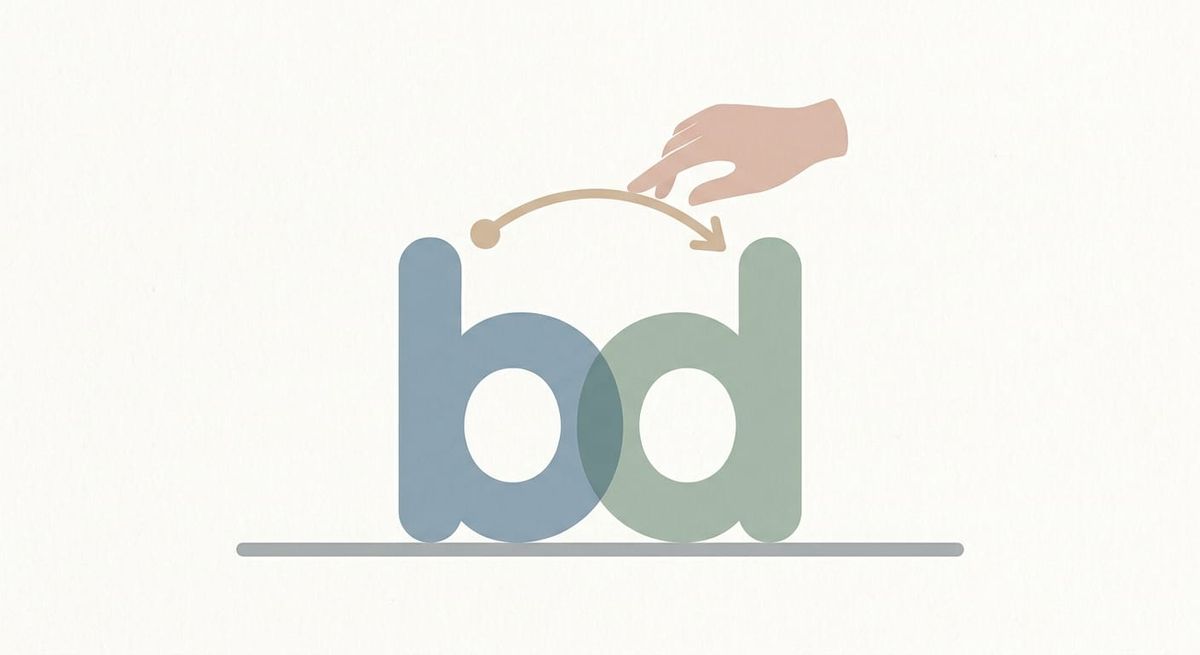
If your child keeps reading b for d or writing letters backward during practice, it can be hard to know what to do in the moment. You may wonder if you should correct every mistake, ignore it, or go back and reteach everything.
The good news is that reversals in Orton-Gillingham do not automatically mean your child is not learning. Many struggling readers need more repeated, explicit practice to make letter patterns feel stable. What matters most is how you respond.
Are reversals always a sign something is wrong?
Not necessarily. Reversals are common when a child is still building automatic recognition for letters and sounds. This is especially true when letters look alike, like b and d, or when reading still takes a lot of effort.
In Orton-Gillingham-style practice, the goal is not to rush past this. The goal is to make the pattern clearer through direct review and repeated success.
A reversal is more concerning when it happens often, across different tasks, and does not improve with guided practice. If your child only does it sometimes, especially when tired or rushing, that usually points to a need for slower, more supported practice.
What should you do in the moment?
Try to correct reversals clearly, but calmly. You do not need a long explanation every time.
A simple response works better:
- “That letter is d. Start again.”
- “Check the first sound.”
- “Let’s trace it and say it together.”
The key is to stop the error before it becomes a habit, but not turn it into a tense moment. If your child is making many reversals in one sitting, that is usually a sign the task is too hard, too long, or moving too fast.
In that case, shorten the practice and go back to easier review. Accuracy matters more than getting through more words.
How do you build accuracy with confusing letters?
Children often need extra practice with just one small contrast at a time. Instead of mixing many skills together, narrow the focus.
For example, if b and d are the problem, you can:
- practice identifying only those two letters
- trace each letter while saying its sound
- read short word lists that use one pattern, then the other
- use a quick verbal cue your child hears every time
Keep it simple and repeatable. The point is not to create a complicated activity. The point is to help your child notice the difference enough times that it starts to stick.
It also helps to practice when your child is fresh. Reversals often increase when a child is tired, frustrated, or trying to hurry.
A real-world example
Say your child reads the word bad as dad during a short lesson. You stop and say, “Check the first letter.” Your child looks again but still hesitates.
Instead of moving on quickly, you pull out two cards: b and d. You trace each one together, say the sounds, then read three short words with b and three with d. After that, you return to bad.
This time your child reads it correctly.
That kind of small reset is often more useful than correcting the same mistake over and over in a full passage. It keeps practice targeted and gives your child a better chance to succeed.
When should you review instead of pushing ahead?
If reversals keep showing up across several days, it is usually better to review than to introduce something new.
Review is a good idea when:
- your child reverses the same letters often
- reading accuracy drops once those letters appear in words
- your child seems to guess instead of checking carefully
- frustration rises fast during practice
Moving ahead too soon can make practice feel harder than it needs to be. A short review block can actually help your child move faster later because the foundation is stronger.
Simple things to try at home
Here are a few realistic ways to help without making practice feel heavy:
- Use a small contrast set
Focus on one confusing pair, like b and d, instead of correcting many different errors at once. - Keep practice short
Five focused minutes of accurate review is better than twenty minutes of tired mistakes. - Add tracing before reading
If a letter keeps getting mixed up, trace it and say the sound before asking your child to read the word. - Go back to decodable words
Use simple words that let your child succeed with the target letters before asking them to read a full sentence or passage.
One helpful next step
If reversals seem tied to trouble pulling sounds together, blending may be part of the problem too. You might also find this helpful: How to Teach Blending in Orton-Gillingham
Final thoughts
Reversals in Orton-Gillingham are frustrating, but they are not a sign that practice is failing. Usually, they are a sign your child needs slower, clearer repetition with the exact letters that are causing trouble.
Keep corrections calm, keep practice focused, and go back to review when needed. Small, accurate wins add up.
If you want extra support between lessons, ReadGenie gives children structured phonics practice with decodable reading and built-in repetition based on Orton-Gillingham principles and the Science of Reading. You can check it out here: App Store or Google Play.



