How to Handle Letter Reversals in Orton-Gillingham
If your child keeps mixing up letters like b and d during reading practice, it can be hard to know whether to stop, correct it, or let it go. This guide shows how to handle letter reversals in Orton-Gillingham practice at home in a calm, practical way.

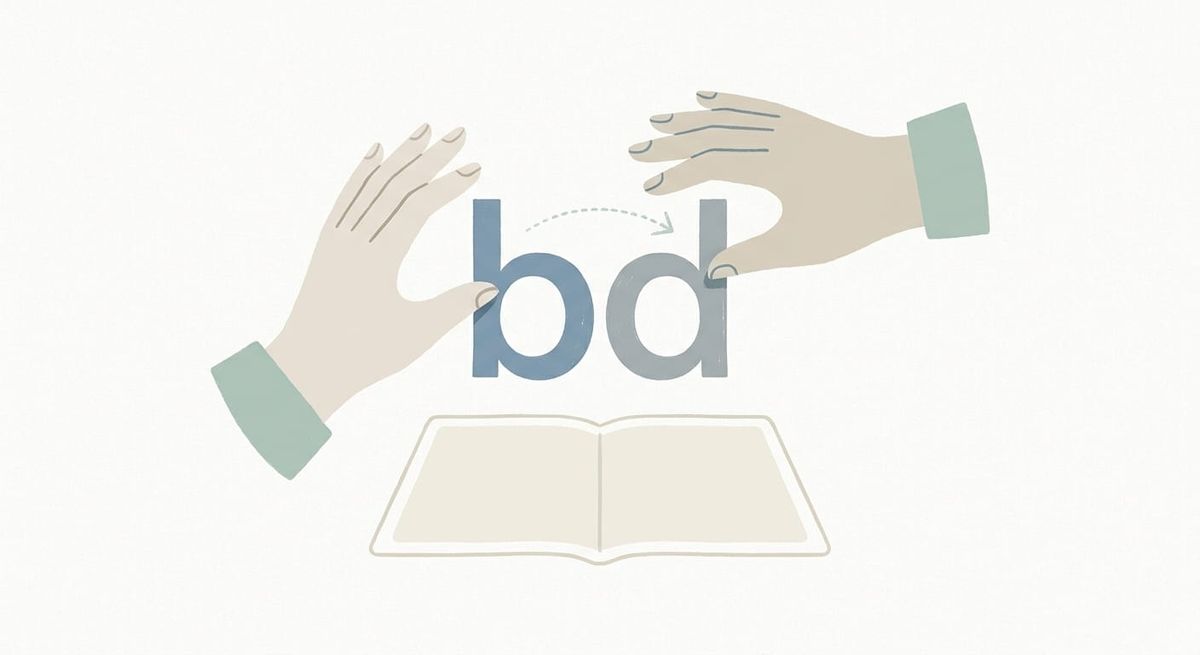
If your child keeps reading b as d or writing was as saw, it can feel like the same mistake is showing up over and over again. Many parents start to wonder whether the lesson is moving too fast, whether their child is not paying attention, or whether they should stop everything and go back.
The good news is that letter reversals do not always mean a child is not learning. What matters more is how you respond during practice. If you are using an Orton-Gillingham approach at home, the goal is not to panic or over-correct. The goal is to make the pattern clear, give the right kind of review, and keep practice steady.
Are letter reversals a sign that something is wrong?
Not always. A child can understand a sound-symbol pattern and still mix up visually similar letters sometimes, especially when reading gets tiring or a word has to be read quickly.
In Orton-Gillingham practice, this usually means you should slow the moment down and make the contrast more obvious. It does not mean you need to turn the whole lesson into a lecture about reversals.
What to watch for is the pattern:
- Does your child reverse the same letters again and again?
- Does it happen more in reading, writing, or both?
- Does it get worse when the text is harder?
- Can your child fix it after a quick prompt?
If your child can usually self-correct with a small cue, that is often a sign the skill is still developing. If the confusion keeps happening even with review, that tells you the letters need more direct practice.
What should you do in the moment?
When a reversal happens, try not to jump in with too many words. A long explanation usually adds stress and takes your child away from the actual task.
Instead, keep the correction short and concrete.
You can try a simple sequence like this:
- Pause on the word.
- Point to the letter that was mixed up.
- Ask, "What letter is this?"
- Have your child say the sound.
- Read the word again.
If needed, bring in a quick reminder your child already knows, such as a visual cue or a handwriting motion practiced before. The key is to reconnect the letter, sound, and word right away.
This works better than saying, "Look more carefully," because it tells your child exactly what to do.
Why do reversals show up more during reading than drills?
A lot of children can name a letter correctly on its own but still reverse it inside a word. That happens because connected reading asks them to do several things at once. They have to track left to right, remember sounds, blend, and keep the whole word in mind.
So if reversals seem worse in passages than in flashcards, that does not necessarily mean your child forgot the letter. It may mean the reading load is too high in that moment.
That is a useful clue. Often the best next step is not more random review. It is easier text, shorter words, or a smaller set of patterns in the same lesson.
A real-world example
Lena, a fourth grader, could usually name b and d correctly in isolation. But when she read a decodable passage, she kept turning bird into dird and bad into dad. Her mom started stopping her every few seconds, which made Lena more flustered.
What helped was making the correction shorter and more consistent. Instead of explaining each mistake, her mom paused, pointed to the letter, asked for the sound, and had Lena reread the whole word. They also spent two minutes before reading reviewing just a few words with b and d in clear contrast.
Within a couple of weeks, Lena was not perfect, but she was catching more of her own mistakes and moving through reading with less tension.
Simple ways to support letter reversals at home
You do not need to overhaul your whole routine. A few small changes can help a lot.
1. Contrast confusing letters directly
Practice pairs like b/d or p/q side by side instead of reviewing them separately. The contrast helps your child notice what is different.
2. Keep review brief but frequent
Two or three minutes of targeted review works better than one long drill session. Short review is easier to repeat and less likely to cause shutdown.
3. Use reading and writing together
If your child reads a word with b, have them also write one or two b words. This strengthens the connection between seeing, saying, and forming the letter.
4. Lower the load when needed
If reversals increase during harder text, switch to a shorter decodable passage or fewer words at once. Success with simpler material often builds accuracy faster than pushing through frustration.
When should you review more?
If your child keeps reversing the same letters across multiple days, it is worth building in extra review before moving on. That does not mean stopping all progress. It means giving those letters a more secure place in the routine.
A good rule is this: if the error is frequent, predictable, and not improving with quick prompts, the skill probably needs more direct practice.
You might also find this helpful: How to Correct Mistakes in Orton-Gillingham at Home
Conclusion
Letter reversals can feel alarming, but they are often a sign that your child needs clearer contrast and steadier review, not more pressure. In Orton-Gillingham practice, calm correction and targeted repetition usually help more than big explanations.
If you want extra support, ReadGenie gives children short, structured reading practice with decodable text, repetition, and skill-based review that fits naturally alongside home learning. You can check it out here: App Store and Google Play.



