Pete the Cat Reading Level: Lexile, AR and Guided Reading Guide
Pete the Cat: I Love My White Shoes is AD460L, AR level 1.5 and Guided Reading level K, so most kids read it alone in 1st grade. Here's how its sing-along pattern helps struggling readers, and where it falls short.

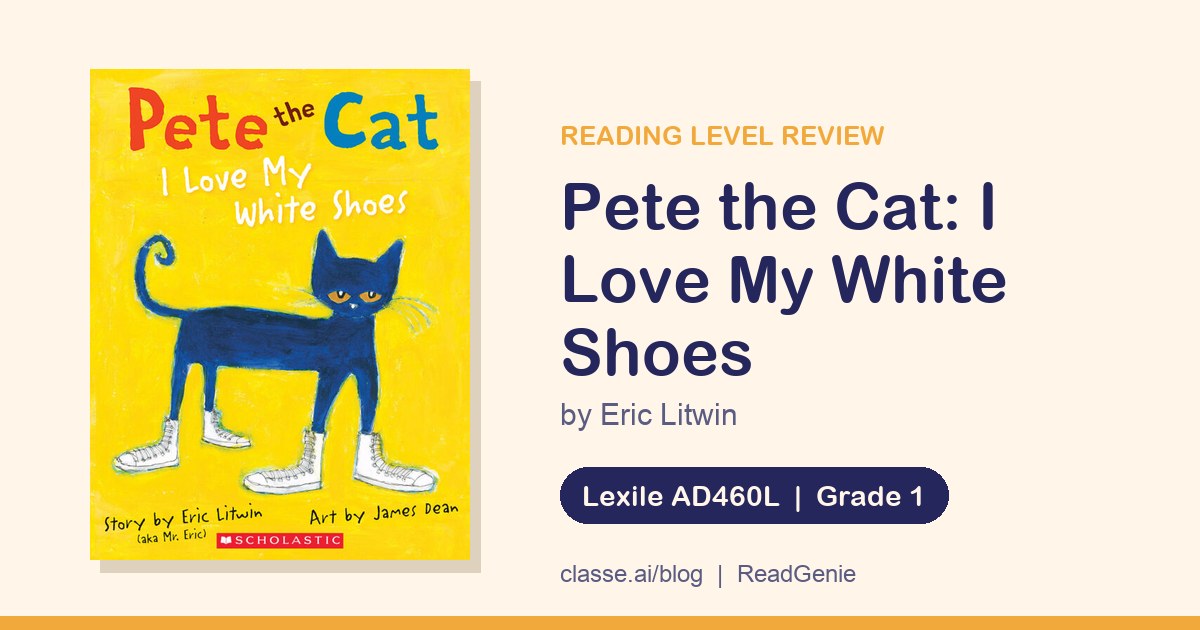
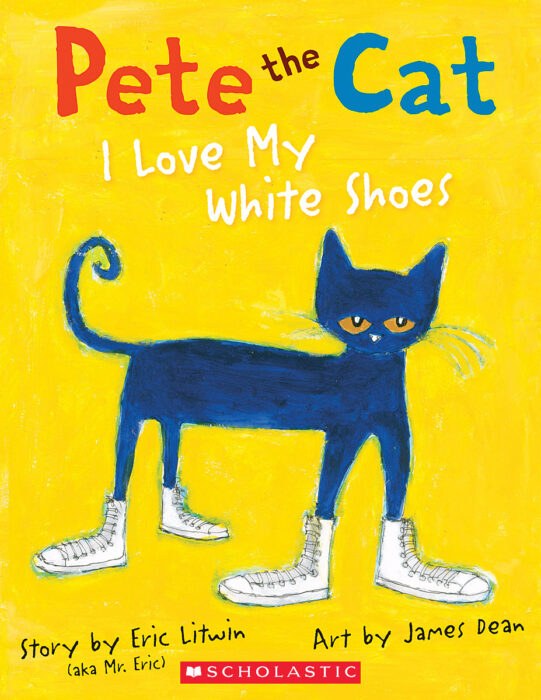
Pete the Cat: I Love My White Shoes by Eric Litwin, with art by James Dean, has an AD460L Lexile measure, an AR (ATOS) book level of 1.5 and a Guided Reading level of K. Most kids can read it on their own by the middle or end of 1st grade, and preschoolers love it as a read-aloud. For a beginning reader who struggles, it's one of the best confidence builders around, because the same short pattern repeats on every page. The catch is that kids memorize it fast, so you have to check they're reading the words and not just singing them.
The story fits on a sticky note. Pete walks down the street in his new white shoes, steps in one messy thing after another, and his shoes change color each time. Pete never gets upset. He just keeps walking and singing his song. Kids figure out the pattern by the second page, shout out the next color before you turn the page, and want to hear it again the minute it ends. It's the first book in the Pete the Cat series, the one that started it all.
Pete the Cat: I Love My White Shoes reading level at a glance
| Lexile measure | AD460L (Scholastic Teacher Store) Also listed as 460L and 460L |
|---|---|
| ATOS / AR book level | 1.5 (TeachingBooks) |
| AR points | 0.5 (TeachingBooks) |
| Guided Reading (Fountas & Pinnell) | K (Scholastic Teacher Store) |
| DRA level | 16-18 (Scholastic Teacher Store) |
| Interest level | Grades Pre-K to 1 (Scholastic Teacher Store) Also listed as Grades PK-2 |
| Approximate grade band | Grade 1 (ages 6-7) ReadGenie |
| Length | 40 pages, ~275 words |
| Format | Picture book |
| Good for struggling readers? | ★★★★★ 3/5 |
| Dyslexia-friendly rating | ★★★★★ 4/5 |
We couldn't find a published grade level equivalent or Flesch score for this book.
Scores checked 2026-11-03. Different leveling systems don't always agree, so we show each published value with its source and mark our own estimates. Links to every source are under How we rate books.
Is your child working hard and still getting stuck on words?
ReadGenie helps struggling readers improve their reading, spelling and handwriting with Orton-Gillingham practice at home. Your child reads out loud, the app listens, and it helps with the exact sound they missed. Join today and we'll mail your child Pete the Cat: I Love My White Shoes for free.
Try ReadGenie and get your free bookStarts with a free 7-day trial. Book mailed after your first paid month. US only, one per family.
What grade level is Pete the Cat?
I Love My White Shoes reads at about a 1st grade level. An AR level of 1.5 means the text is about as hard as what a typical student reads in the middle of 1st grade. Guided Reading level K and DRA 16 to 18 point to the same place, roughly the end of 1st grade, when many schools expect kids to read short books like this alone.
The AD in front of the Lexile number stands for adult-directed. It means the book was written to be read aloud to children first, not handed to them on day one. That's exactly how it works in real life. A four-year-old hears it, sings along, and two years later can read it.
That gap surprises a lot of parents. The book looks like it's for preschoolers, with big bright pictures and very few words, yet the official levels put independent reading in 1st grade. The reason is that the few words it has aren't all easy. Strawberries, blueberries and goodness are long words for a new reader, and shoes, love and water don't sound the way they're spelled. Scholastic sells it for grades Pre-K to 1, and that range covers both uses, listening when kids are little and reading it themselves later.
A note if you're searching for other Pete the Cat books. The series has grown to include many picture books plus a separate line of I Can Read books, and each title has its own level. The I Can Read titles are written for kids reading on their own, so don't assume a later Pete book matches this one.
Is Pete the Cat good for struggling readers?
For a struggling reader in kindergarten or 1st grade, yes. We give it 3 out of 5 for struggling readers overall, because it works very well for young kids and much less well for older ones.
Repetition is its superpower. Each spread follows the same frame. Pete steps in something, his shoes change color, the book asks a question, and Pete answers the same calm way. A child who reads one spread has already practiced most of the words on the next one, so every page feels a little easier than the last. With only about 275 words in the whole book, a child can finish it in a single sitting and feel like a reader.
The pictures help too. Each spread shows exactly what Pete stepped in and what color his shoes turned, so a child who reads a color word wrong can look at the picture and fix it. That's the kind of self-check new readers need.
Pete himself is part of the appeal. A child who gets upset over every mistake meets a cat who doesn't. The book's message is simple enough for a five-year-old to repeat back, and it gives you an easy phrase to borrow at homework time.
Two things keep it from scoring higher. First, it looks young. A 2nd or 3rd grader reading at a 1st grade level may feel embarrassed to carry it, and that matters more than the level. Second, the same repetition that builds confidence also lets kids fake it. Many children can recite the whole book from memory after two reads. If your child is reading it fluently, cover the picture for a page and point to a color word. If they can read it without the picture, they're reading.
Is Pete the Cat good for kids with dyslexia?
Overall: ★★★★★ 4/5
| Factor | Score | Why |
|---|---|---|
| Sentence length | 5/5 | Short lines and short questions, repeated in the same order on each spread. |
| Vocabulary load | 4/5 | Mostly everyday words and color words, plus a few long food words like strawberries and blueberries. |
| Decodability | 3/5 | Some regular words like red, wet and mud, but shoes, love, water and color don't follow the patterns a beginner knows. |
| Text density and layout | 4/5 | Large pages with a few lines of big type and lots of space, though the words sit on busy, colorful art. |
| Pictures that carry meaning | 5/5 | Every spread shows exactly what Pete stepped in and what color his shoes turned. |
| Chapter length | 5/5 | The whole book takes a few minutes to read, with natural pauses at every color change. |
| Engagement for reluctant readers | 5/5 | Kids sing along, guess the next color and laugh at Pete's calm answer every time. |
| Audiobook / read-along support | 4/5 | The author recorded the song, TeachingBooks links an audio excerpt narrated by Eric Litwin, and there is a Pete the Cat TV series. We didn't confirm a current standalone audiobook. |
We give it 4 out of 5 on our dyslexia-friendly scale. It scores highest on sentence length, picture support, length and engagement. The lines are short, there are only a few of them per page, and the book is over in minutes. For a child with dyslexia who tires quickly, that's a real plus. They get the feeling of finishing a book without running out of energy halfway.
Decoding is the weak spot. Some words follow simple patterns that an Orton-Gillingham student learns early, like red, wet, mud and Pete. Others don't. Shoes, love, water and color are irregular, and they come up again and again. If your child is reading in a structured literacy program, treat those as heart words and teach them before you start.
The layout is mostly friendly. The type is large and there's plenty of space around it, but the words sit on busy, colorful art. Some dyslexic readers find it easier to follow along with a finger or a card under the line.
Audio support is good. Eric Litwin is a musician as well as the author, and he recorded the song that goes with the book. TeachingBooks links an audio excerpt he narrates, and many libraries carry book-and-CD editions. There's also a Pete the Cat TV series. Hearing the rhythm first makes the text much easier to read later, so playing the song before reading is a smart move for a dyslexic child.
Words and phonics patterns to practice first
This book works well for kids in a structured literacy program who know closed syllables and are starting silent e. These are the patterns your child will meet most often.
- Closed syllables with short vowels, like red, wet, mud, did and cat. Stepped adds a blend and the -ed ending.
- Silent e, as in white, Pete and pile. Point out that the e at the end is quiet and makes the i say its name.
- Digraphs wh, sh, th and ng, in white, what, shoes, the, song and along.
- Blends like str in street, br in brown and bl in blue.
- The ee in street and keep, and the ow in brown and down.
- The -ing ending in walking and singing. Cover the ending, read the base word, then add it back.
The words to pre-teach are shoes, love, what, water, color, goodness, strawberries, blueberries, bucket and cry. Shoes, love, what, water and color are irregular, so practice them as heart words before you open the book. Strawberries and blueberries are long, but each is a compound word. Split them into straw and berries, blue and berries, and they stop being scary. Cry is a good place to show that y at the end of a short word can say long i.
Practicing these exact patterns is what ReadGenie does every day. Your child reads aloud, the app listens, and it helps with the sound they missed, so a book like this becomes one they can read and not just recite.
How to read Pete the Cat with your child
Read or sing it to your child first. The first time through, it's a song, and that's fine. The second time, you read the parts that change and your child reads the parts that repeat. By the third read, swap roles.
Before each page turn, ask what color the shoes will be. Then point to the color word and have your child read it. Guessing from the picture is a reading skill too, but you want to see them look at the letters.
Every so often, cover the picture with your hand. If your child can still read red, blue or brown without seeing the color, the word is theirs. If they can't, that's useful information, not a failure. Pete would say so too.
The book is short enough to read every night for a week, and that's a good plan for a beginning reader. Each night they'll read a little more of it on their own. When they can read the whole thing without help, celebrate it, then move to a new book at the same level so the skill carries over.
Finally, borrow Pete's attitude. When your child makes a mistake later in the week, ask what Pete would do. It turns the book's message into something your family can use.
Using Pete the Cat in the classroom or tutoring
For teachers, I Love My White Shoes fits a Guided Reading level K group in 1st grade and works as shared reading in kindergarten. It's a natural anchor for color words and for sequencing, since students can retell the order of the messes and the colors in the right order. A simple writing extension is to have each student write and draw a new page with their own messy thing and the color it would turn Pete's shoes.
For tutors, it's good connected text once closed syllables and silent e are secure. Have the student find and underline every word with a pattern they've learned, then read only those words aloud before reading the whole page. Because the text repeats, it's also a good fluency piece. Read a spread twice for smoothness, then move on, and track how much faster the later pages go.
Content notes for parents
There's nothing scary in this book, no villains and no potty humor. Pete's shoes get messy and then wet, and he stays calm each time. The message is simple. Things change, and you can keep going anyway.
Should your child read it?
If your child is in kindergarten or 1st grade and reading is hard for them, this is a great book to start with, as a sing-along first and a reading book later. If they're reading around Guided Reading level K and still enjoy it, let them read it to a younger sibling, which turns rereading into a job instead of a chore. If your child is older and the book feels too young, try Henry and Mudge: The First Book or Frog and Toad Are Friends instead, which look more grown up at a similar reading stage.
Make the next book easier
Short daily sessions of reading, spelling and handwriting practice, built with Orton-Gillingham teachers. It works alongside tutoring and school support. The first 7 days are free. Join today and we'll mail your child Pete the Cat: I Love My White Shoes for free.
Try ReadGenie and get your free bookStarts with a free 7-day trial. Book mailed after your first paid month. US only, one per family.
FAQ
What age is Pete the Cat good for?
Scholastic sells it for grades Pre-K to 1. Kids ages 3 to 5 enjoy it as a read-aloud and sing-along, and most kids can read it on their own around age 6 or 7, in 1st grade.
What is the AR level of Pete the Cat: I Love My White Shoes?
It has an ATOS book level of 1.5 and is worth 0.5 AR points. Other Pete the Cat books have their own AR levels, so check the specific title your child is reading.
What is the Pete the Cat guided reading level?
I Love My White Shoes is listed at Guided Reading level K and DRA 16 to 18. That usually lines up with the end of 1st grade.
What does AD mean in the Pete the Cat Lexile?
AD stands for adult-directed. It means the book is meant to be read aloud by an adult at first, before children read it on their own.
Why can my child read Pete the Cat but not other books at the same level?
The repeated lines make this book much easier than its level suggests, and many kids know it by heart. Test a few words with the picture covered. If your child stumbles, practice those words and patterns before moving on.
Is Pete the Cat good for kids with dyslexia?
It can be a good fit for young readers with dyslexia. The text is short and repetitive and the pictures show every color change. Pre-teach the irregular words like shoes, love and water, and play the song first so the rhythm carries them.
Get Pete the Cat: I Love My White Shoes free
ReadGenie helps struggling readers improve their reading, spelling and handwriting in short daily sessions at home. Join and we'll mail your child this book for free.
Claim your free bookStarts with a free 7-day trial. Book mailed after your first paid month. US only, one per family.
What to read next
- Biscuit Goes to School by Alyssa Satin Capucilli (easier). A My First I Can Read book with very short, repeated lines a beginner can read alone.
- We Are in a Book! by Mo Willems (similar). Speech-bubble text, big laughs and lots of repetition, built for kids reading on their own.
- Henry and Mudge: The First Book by Cynthia Rylant (harder). Short chapters about a boy and his big dog, with simple sentences and a cozy tone.
- Hi! Fly Guy by Tedd Arnold (harder). A short, silly early reader that looks less young, good for a kid moving past picture books.
- Frog and Toad Are Friends by Arnold Lobel (harder). Short chapters with a gentle tone, a next step once a child reads level K books with ease.
Browse all of our reading-level book reviews.
How we rate books
Lexile, ATOS (Accelerated Reader), Guided Reading and DRA levels come from the companies that own them and from publishers. We link to where we found each one, and when a level isn't published we say so. Anything marked "ReadGenie estimate" is our own call, not an official level. Flesch scores come from a short public excerpt when the publisher offers one. The struggling-reader and dyslexia-friendly ratings are our judgment, based on eight things (sentence length, vocabulary, decodability, page layout, pictures, chapter length, how gripping the story is, and audiobook support). Treat them as a starting point. The right book is one your child can read with about 95% accuracy and wants to keep reading.
Sources
- Scholastic Teacher Store: Pete the Cat: I Love My White Shoes (Lexile, Guided Reading level, DRA level, ACR level, page count, ISBN, grades)
- TeachingBooks: I Love My White Shoes (ATOS, AR points, Lexile, word count, grades, Spanish edition, author audio excerpt)
- Nashville Public Library catalog: Pete the Cat: I Love My White Shoes (Lexile (NoveList))