Percy Jackson Reading Level: The Lightning Thief Lexile & AR Guide
The Lightning Thief is Lexile 680L, AR 4.7 and Guided Reading level W, so most kids read it alone in 5th or 6th grade. The sentences are easy, the book is long, and the hero has dyslexia. Here's how to make it work for a child who struggles.

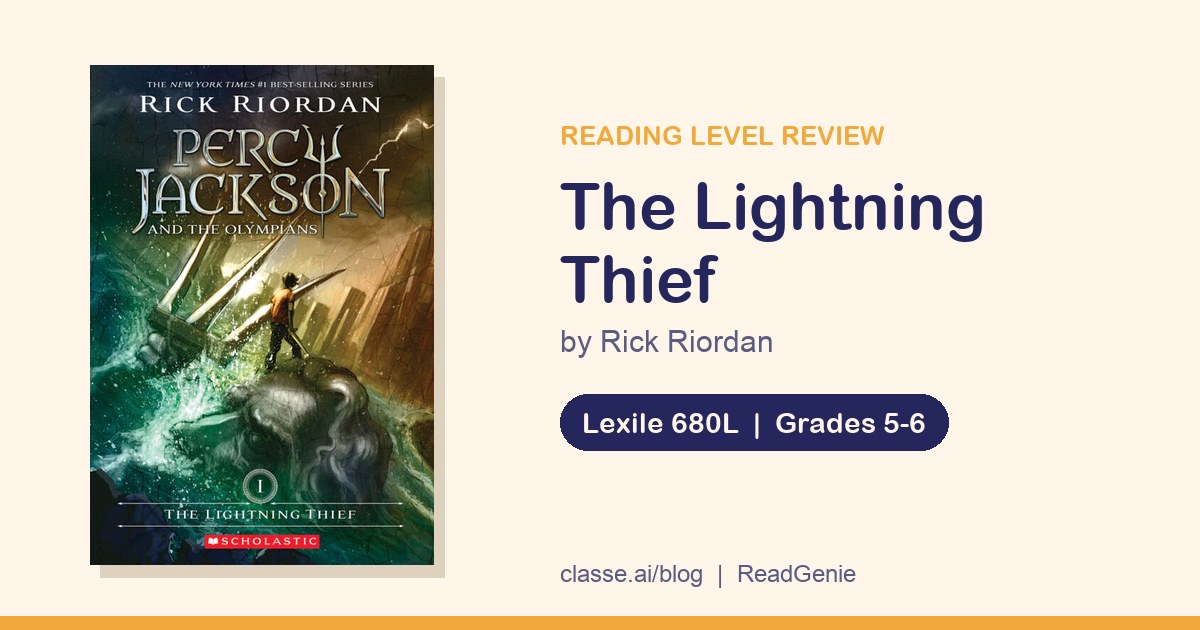
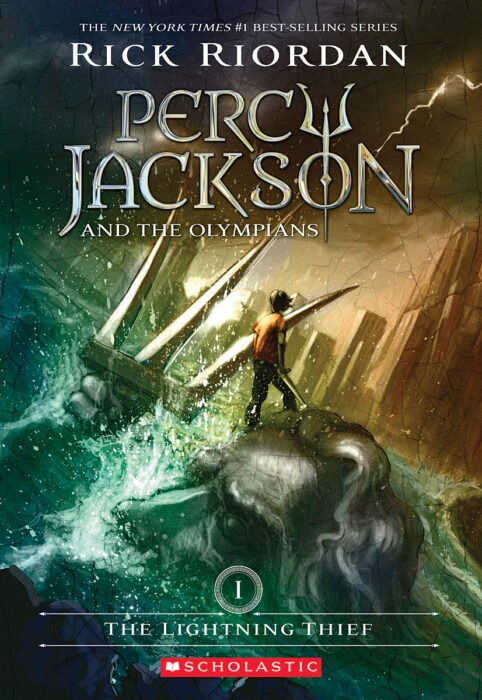
The Lightning Thief, the first Percy Jackson book by Rick Riordan, has a 680L Lexile measure, an AR (ATOS) book level of 4.7 and a Guided Reading level of W. Most kids can read it on their own in 5th or 6th grade. The sentences are easier than that level suggests, but at about 87,000 words, with long chapters and a crowd of Greek names, it is a big book for a struggling reader. Kids reading below grade level do best with the audiobook alongside or a grown-up sharing the reading, and many kids with dyslexia get hooked because Percy has dyslexia too.
Percy is twelve, and he has been kicked out of six schools. He has dyslexia and ADHD, and trouble seems to find him. On a class trip to a museum, his math teacher turns into a monster and attacks him. Soon he learns why. His father is a Greek god, and the gods of Olympus are very much alive. At Camp Half-Blood he is blamed for stealing Zeus's lightning bolt, and he heads across the country with his friends Grover and Annabeth to find it before the gods go to war. Kids love Percy because he is funny, a little sarcastic and not at all the perfect hero, and the Disney+ series has brought a new wave of readers to the books.
The Lightning Thief reading level at a glance
| Lexile measure | 680L (Scholastic Teacher Store) |
|---|---|
| ATOS / AR book level | 4.7 (TeachingBooks) |
| AR points | 13 (TeachingBooks) |
| Guided Reading (Fountas & Pinnell) | W (Scholastic Teacher Store) |
| DRA level | 60 (Scholastic Teacher Store) |
| Flesch Reading Ease (0-100) | 84.8 ReadGenie estimate |
| Flesch-Kincaid grade | 4.5 ReadGenie estimate |
| Interest level | Ages 8-12 (Disney Books) |
| Approximate grade band | Grades 5-6 (ages 10-12) ReadGenie |
| Length | 384 pages, ~87,223 words |
| Format | Middle grade novel |
| Good for struggling readers? | ★★★★★ 3/5 |
| Dyslexia-friendly rating | ★★★★★ 3/5 |
We couldn't find a published grade level equivalent for this book.
Scores checked 2026-11-04. Different leveling systems don't always agree, so we show each published value with its source and mark our own estimates. Links to every source are under How we rate books.
Is your child working hard and still getting stuck on words?
ReadGenie helps struggling readers improve their reading, spelling and handwriting with Orton-Gillingham practice at home. Your child reads out loud, the app listens, and it helps with the exact sound they missed. Join today and we'll mail your child The Lightning Thief for free.
Try ReadGenie and get your free bookStarts with a free 7-day trial. Book mailed after your first paid month. US only, one per family.
What grade level is The Lightning Thief?
The Lightning Thief reads at about a 5th to 6th grade level, but the different measures tell slightly different stories, and that is useful to know.
The Lexile measure of 680L and the AR level of 4.7 both sit around 4th to 5th grade. Those numbers mostly look at sentence length and how common the words are. Riordan writes in a fast, chatty first-person voice with plain everyday words, so line by line the text isn't hard. Our check of the publisher's chapter 1 extract found sentences averaging about 12 words.
The Guided Reading level W and DRA 60 put it higher, around the end of 5th grade into 6th. Those levels weigh the whole book, including length, the number of characters, and the background a reader needs. At 384 pages and 13 AR points, it is a long novel, and it expects kids to keep track of gods, monsters and myths they may never have heard of.
So a child at level S or T can often read a page of it fine but run out of steam over a whole chapter. At level W and above, most kids can handle it alone. The later books in the series stay at about the same Lexile and AR level, so a child who finishes book 1 can keep going without a big jump.
Is The Lightning Thief good for struggling readers?
It can be, with support. We give it 3 out of 5 for struggling readers.
The writing itself is friendly. Percy talks straight to the reader, makes jokes about his own bad luck, and the action starts in the very first chapter. Short punchy sentences are mixed through every page. Because it is the book a lot of 5th and 6th graders are reading, and it looks like a real novel, an older child reading a year or two behind won't feel singled out carrying it.
There is also something special here for kids who find reading hard. Percy has dyslexia and ADHD, and the book turns both into part of who he is as a hero. A child who has spent years feeling slow at reading may see themselves in him for the first time.
The hard part is size. With 22 chapters in about 87,000 words, each chapter runs around 15 to 20 pages. A slow reader can spend half an hour on one chapter and still not reach a stopping point. There are no pictures inside to rest on, and new Greek names keep arriving all the way through the book.
Here is who it fits and who it may frustrate.
- Great for 5th to 7th graders reading a little below grade level, especially with the audiobook.
- Great for kids with dyslexia or ADHD who want a hero like them.
- Harder for kids reading below Guided Reading level S. Read it aloud together or start with the graphic novel.
- Harder for kids who lose track of lots of characters, unless you keep a name list handy.
Is The Lightning Thief good for kids with dyslexia?
Overall: ★★★★★ 3/5
| Factor | Score | Why |
|---|---|---|
| Sentence length | 3/5 | Sentences average about 12 words in chapter 1. Lots of short punchy ones, mixed with longer ones full of jokes and asides. |
| Vocabulary load | 3/5 | Everyday words carry most of the story, but school and museum words like probation, sarcophagus and mythology show up early. |
| Decodability | 2/5 | The Greek names and places break normal spelling rules, and new ones arrive in almost every chapter. |
| Text density and layout | 2/5 | Standard middle grade paperback with small print and full pages. |
| Pictures that carry meaning | 1/5 | Text only. The pictures live in the separate graphic novel. |
| Chapter length | 2/5 | 22 chapters in about 87,000 words, so each one runs close to 4,000 words, around half an hour for a slow reader. |
| Engagement for reluctant readers | 5/5 | Monster attacks, sword fights and a road trip, told by a funny narrator kids relate to. The Disney+ series adds pull. |
| Audiobook / read-along support | 5/5 | Listening Library publishes an unabridged audiobook read by Jesse Bernstein, held by most public libraries. |
We give it 3 out of 5 on our dyslexia-friendly scale. Its top marks are for engagement and audio, and its lowest are for pictures, page layout and chapter length.
Audio is the strongest support here. Listening Library publishes an unabridged audiobook read by Jesse Bernstein, and most public libraries carry it. Listening while following the printed page lets a dyslexic child enjoy the story at full speed and still see every word. For a lot of kids, that is the difference between giving up at chapter 3 and finishing the book.
The layout is standard middle grade print. Pages are full, the type is small and there are no drawings, so a tired reader has nowhere to pause. Using a reading guide card under each line and stopping at scene breaks helps a lot.
Decoding is the real challenge, and it comes mostly from names. Chiron, Poseidon, Medusa and Hades don't follow English spelling rules, so a child can't sound them out the usual way. The good news is that the everyday words around them are fairly regular, so once the names are learned, the rest of the text goes more smoothly.
There is also a graphic novel version of The Lightning Thief with far fewer words. It tells the same story with pictures carrying much of it, so it works as a first read or as a way to catch up before tackling the novel.
Words and phonics patterns to practice first
If your child is in an Orton-Gillingham or structured literacy program, this book works best once vowel teams, r-controlled vowels and common suffixes feel solid. These are the patterns that show up again and again in the first chapter.
- Closed syllables with short vowels, like trip, bus, sixth, kids, shut and stuck.
- Digraphs and the -ck ending, as in shirt, wish, thing, black, jacket and Jackson.
- Vowel teams in Greek, teacher, sleep, brain, throat and real.
- R-controlled vowels in sword, short, girl, first, hurt and marble.
- The igh and -dge spellings in right, fight, midnight, lightning, edge and dodged.
- The suffix -tion in question, detention, attention, probation, collection and section.
The words to pre-teach are Percy, Grover, Annabeth, Chiron, Poseidon, Zeus, Hades, Medusa, Olympus and sarcophagus. Most of these are Greek names, and they don't sound the way they look. Chiron starts with a k sound, and Poseidon and Medusa put the stress in places a child won't expect. Say each one out loud, have your child repeat it, then write it on a name card they can use as a bookmark. Sword is worth a quick word too, since the w is silent.
This kind of targeted pattern practice is what ReadGenie does each day. Your child reads aloud, the app listens, and it helps with the exact sound they missed, so the regular words in a book like this stop slowing them down.
How to read The Lightning Thief with your child
Before you start, tell your child that Percy has dyslexia and ADHD. It gives them a reason to keep going when the book feels long.
Make a name card with the main characters and gods. Grover, Annabeth, Chiron, Zeus and Poseidon are enough to begin. Keep it in the book and add names as they come up.
The chapters are long, so split each one into two sittings. Stop at a scene break, where the text leaves a little gap, rather than at the bottom of a page. Two half chapters a night gets you through the book in about three weeks.
Take turns. You read a section, your child reads the next. On tired nights, let them follow the audiobook for a chapter and then read the first page or two of the next chapter to you. That keeps the story moving and still gives real reading practice.
Watching the Disney+ series after every few chapters makes a fun reward, and it helps a slower reader keep the plot straight. Talk about what the show changed.
Using The Lightning Thief in the classroom or tutoring
For teachers, The Lightning Thief fits a Guided Reading level W group. For a group reading a little below grade, about two chapters a week is a steady pace. A short unit on Greek myths before you start helps students meet the gods before the book does. Offering the audiobook or the graphic novel to students reading below level lets the whole class talk about the same story.
For tutors, the everyday text is fairly plain, so most of the decoding work is in the names. Teach them as a short list before each chapter. Chapter 1 has a run of -tion words, like detention, attention and probation, which makes a quick suffix lesson. For fluency, pick a short passage from a fight scene for repeated reading. The pace pulls kids into reading it faster and more smoothly each time.
Content notes for parents
This is an action fantasy, so there is a lot of fighting with swords and monsters, and some characters die. Percy's stepfather is cruel and gross, and his mom stays with him to keep Percy safe, which some kids find upsetting. One section takes place in the Underworld, with ghosts and spooky scenes. Expect mild insults and name calling, but no strong swearing and no romance.
Should your child read it?
If your child reads around Guided Reading level S or above and loves adventure or mythology, this is a great pick, especially with the audiobook. Kids with dyslexia often love it most of all. If they're reading lower than that, read it aloud together for now, try the graphic novel, or build stamina with a shorter book like The Wild Robot or Niagara Falls, or Does It? When they finish, the rest of the series stays at about the same level.
Make the next book easier
Short daily sessions of reading, spelling and handwriting practice, built with Orton-Gillingham teachers. It works alongside tutoring and school support. The first 7 days are free. Join today and we'll mail your child The Lightning Thief for free.
Try ReadGenie and get your free bookStarts with a free 7-day trial. Book mailed after your first paid month. US only, one per family.
FAQ
What age is Percy Jackson for?
Disney Hyperion publishes it for ages 8 to 12, and Scholastic lists it for grades 6 to 8. Most kids read it on their own around age 10 to 12. Younger kids often enjoy it as a read-aloud, and older kids who are behind in reading still find it exciting.
What is the AR level of The Lightning Thief?
The Lightning Thief has an ATOS book level of 4.7 and is worth 13 AR points. The high point count reflects its length, at about 87,000 words.
What is the Lexile level of Percy Jackson?
The first book, The Lightning Thief, has a Lexile measure of 680L. The last book in the original series, The Last Olympian, is listed a little lower, so the whole series stays in the 600s.
What reading level letter is Percy Jackson?
The Lightning Thief is Guided Reading level W, which most schools expect around the end of 5th grade or the start of 6th. Its DRA level is 60.
Does Percy Jackson have dyslexia?
Yes. Percy has dyslexia and ADHD, and the book explains them as part of being a half-blood. For many kids who struggle with reading, that makes Percy easy to root for.
Is there an easier version of The Lightning Thief?
Yes. The Lightning Thief graphic novel tells the same story with pictures and far fewer words. It is a good first step for a child who isn't ready for the full novel, or a way to catch up on the story before reading it.
Get The Lightning Thief free
ReadGenie helps struggling readers improve their reading, spelling and handwriting in short daily sessions at home. Join and we'll mail your child this book for free.
Claim your free bookStarts with a free 7-day trial. Book mailed after your first paid month. US only, one per family.
What to read next
- The Lightning Thief (The Graphic Novel) by Rick Riordan (easier). The same story in comic form with far fewer words, a good first step or a way to catch up.
- The Wild Robot by Peter Brown (easier). A shorter novel with tiny chapters, good for building stamina first.
- Rise of the Earth Dragon by Tracey West (easier). Dragons, magic and battles at a much lower level, for younger fans.
- Niagara Falls, or Does It? by Henry Winkler & Lin Oliver (easier). Another funny hero with dyslexia, in a shorter book.
- The Dragonet Prophecy by Tui T. Sutherland (similar). A long fantasy series with the same pull, and graphic novel editions too.
- Harry Potter and the Sorcerer's Stone by J.K. Rowling (harder). The other big fantasy series kids reach for next, with harder vocabulary.
Browse all of our reading-level book reviews.
How we rate books
Lexile, ATOS (Accelerated Reader), Guided Reading and DRA levels come from the companies that own them and from publishers. We link to where we found each one, and when a level isn't published we say so. Anything marked "ReadGenie estimate" is our own call, not an official level. Flesch scores come from a short public excerpt when the publisher offers one. The struggling-reader and dyslexia-friendly ratings are our judgment, based on eight things (sentence length, vocabulary, decodability, page layout, pictures, chapter length, how gripping the story is, and audiobook support). Treat them as a starting point. The right book is one your child can read with about 95% accuracy and wants to keep reading.
Sources
- Scholastic Teacher Store: Percy Jackson & the Olympians: The Lightning Thief (paperback) (Lexile, Guided Reading level, DRA, ACR level, ISBN, page count, grades)
- TeachingBooks: The Lightning Thief (ATOS, AR points, Lexile, word count, Spanish edition, graphic novel edition)
- TeachingBooks: The Last Olympian (series Lexile and ATOS range)
- TeachingBooks: The Lightning Thief (Graphic Novel) (graphic novel level)
- Penguin Books Australia: Percy Jackson and the Lightning Thief extract (readability excerpt, phonics patterns)
- Disney Books: The Lightning Thief Deluxe Collector's Edition (ages)
- Fayetteville Free Library catalog: The Lightning Thief audiobook (audiobook)
- Open Library (first publication year, ISBNs)