What Order to Teach Phonics in Orton-Gillingham
If you are trying to help your child with reading at home, one of the hardest parts is knowing what to teach next. This guide explains the order to teach phonics in Orton-Gillingham so practice feels clearer, more structured, and less overwhelming.

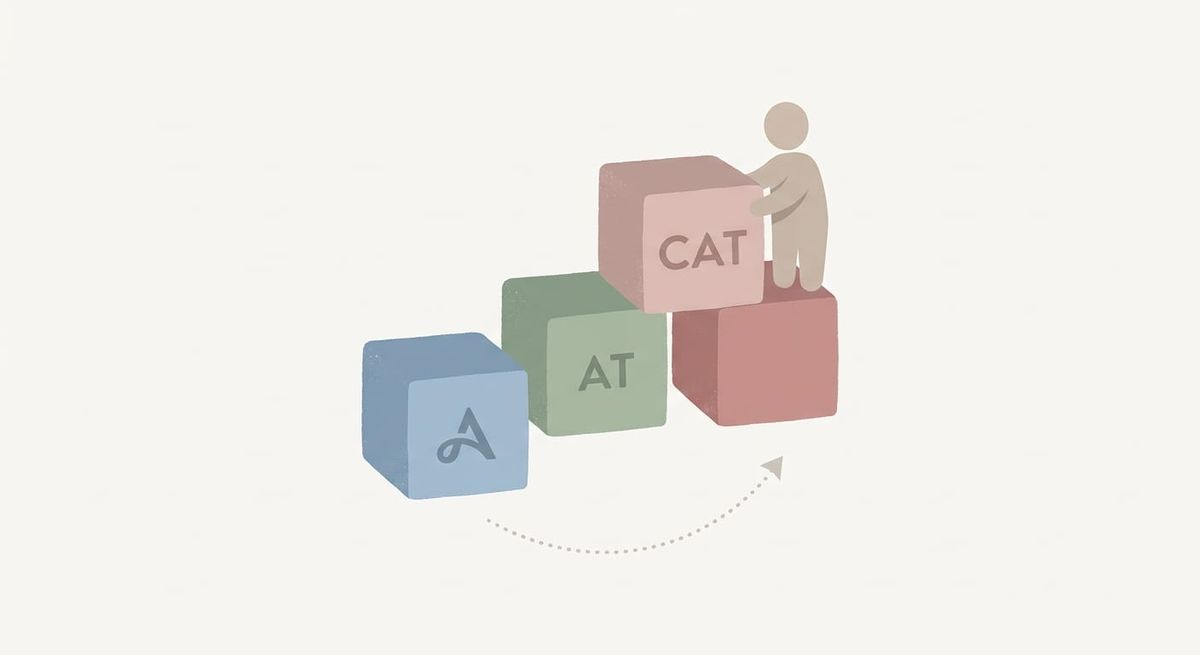
If you are trying to help your child with reading at home, one of the hardest parts is not the practice itself. It is figuring out what comes next.
You may work on one skill for a few days, then wonder whether to move to blends, long vowels, syllables, or sight words. When practice feels random, kids often feel that too. They can get frustrated, guess more, or shut down because the work does not feel connected.
This guide will help you understand the order to teach phonics in Orton-Gillingham in a simple, parent-friendly way. You do not need to copy a full tutoring plan at home. But it helps to know the general sequence so your child gets practice that builds step by step.
Why does the order matter?
Orton-Gillingham works best when reading skills are taught in a clear sequence. That means your child practices easier patterns first, then adds harder ones once the earlier skills feel more solid.
If a child is still shaky on short vowel words like cat, fish, or stop, jumping straight to multisyllable words can create more confusion than progress. A good sequence lowers guessing and helps your child notice how words are built.
For parents, this matters because it takes away some of the daily uncertainty. Instead of asking, "What should we do tonight?" you can think, "What is the next small step from what my child can already read?"
What is the basic order to teach phonics in Orton-Gillingham?
The exact sequence can vary a little, but this is a simple version parents can use at home:
- Letter sounds and sound-symbol connection
- Short vowel words and closed syllables
- Consonant blends and digraphs
- Magic e or CVCe patterns
- Open syllables
- Common vowel teams
- R-controlled vowels
- More advanced word reading, including syllable division and longer words
The goal is not to rush through the list. The goal is to make sure each new step rests on something your child can already do.
For example, if your child cannot yet read short, simple words smoothly, it usually makes sense to spend more time there before adding long vowel patterns. If your child can read cap and kit easily, then a pattern like cape or kite may be a reasonable next step.
How do you know your child is ready to move on?
This is where many parents get stuck. They worry about either moving too fast or staying too long on the same thing.
A simple rule is this: move on when the skill looks fairly solid, not perfect.
Your child may be ready for the next step if they can:
- read several words with the target pattern without a lot of guessing
- explain the pattern in simple words
- spell a few words with the pattern during dictation
- use the pattern in a short decodable sentence or passage
If the skill falls apart the moment it shows up in real reading, your child probably needs more review.
That does not mean you failed. In Orton-Gillingham, review is part of the plan. Many kids with dyslexia need more repetition before a pattern sticks.
What should parents avoid teaching too early?
The biggest mistake is skipping foundations because a harder skill seems more exciting or more urgent.
For example, a child who struggles to blend sounds may not be ready for a lot of syllable division work yet. A child who guesses at the first letter of a word may need stronger practice with simple decoding before moving into longer vowel patterns.
Try to avoid:
- teaching too many new patterns at once
- mixing unrelated skills in the same session
- using books that contain many patterns your child has not learned yet
- assuming a child knows a skill because they got it right once
Short, focused practice usually works better than trying to cover everything.
A real-world example
Let’s say Maya is in fourth grade and hates reading out loud. Her mom notices that Maya can read some short words like shop and thin, but when she sees words like make or home, she either guesses or freezes.
Instead of jumping into longer books, her mom narrows the focus. For one week, they review short vowel words and blending. The next week, they work on magic e words like cape, bike, and hope. They read those words in a short decodable passage and practice spelling a few out loud.
After that, Maya starts noticing the pattern on her own. She is not suddenly a fluent reader, but she is less likely to guess and more willing to try. That is the kind of progress a clear sequence can create.
Simple ways to use this sequence at home
You do not need an hour-long lesson plan. Try these simple steps instead:
1. Start with what your child can almost do
Choose a skill that is not fully easy but not totally new. That is often the best learning zone.
2. Keep one main focus for the week
If you are working on CVCe words, let that be the main pattern for a few practice sessions. Review old skills briefly, but do not pile on too much.
3. Read words, spell words, then read them in context
A good routine is: read the pattern in word lists, spell a few words, then use the same pattern in a sentence or short decodable text.
4. Review before adding something new
Even when your child is ready for the next step, spend a few minutes reviewing older patterns. This helps keep new learning from pushing old learning out.
What if your child has gaps in several places?
That is very common, especially in grades 3 through 6.
If your child has mixed skills, do not worry about making the sequence perfect. Start with the earliest missing skill that is interfering with reading the most.
For one child, that may be weak blending. For another, it may be confusion with vowel sounds. For another, it may be trouble reading longer words because basic syllable patterns were never secure.
When in doubt, go simpler. Solid practice on a lower-level skill often helps more than pushing a child through a harder one they are not ready to hold onto.
You might also find this helpful: How to Start Orton-Gillingham at Home
If you are trying to figure out both what to teach and how to begin, that guide can help you set up practice in a way that feels manageable.
Conclusion
The order to teach phonics in Orton-Gillingham does not have to feel mysterious. What matters most is teaching skills in a way that builds from simple to more complex, with plenty of review along the way.
If your child is struggling, a clear sequence can make home practice feel calmer and more productive. You do not need to do everything. You just need the next right step.
If you want extra support, ReadGenie gives kids structured reading practice with decodable passages, repetition, and phonics-based lessons designed to build skills step by step. You can explore it here: APPSTOREURL or GOOGLEPLAYURL.



