Dog Man Reading Level: Lexile, AR Level and Grade Guide
Dog Man is Lexile GN390L, AR level 2.6 and Guided Reading level P, so most kids read it alone by the end of 2nd grade or in 3rd. Here's why it works so well for reluctant readers, and what to watch for if your child has dyslexia.

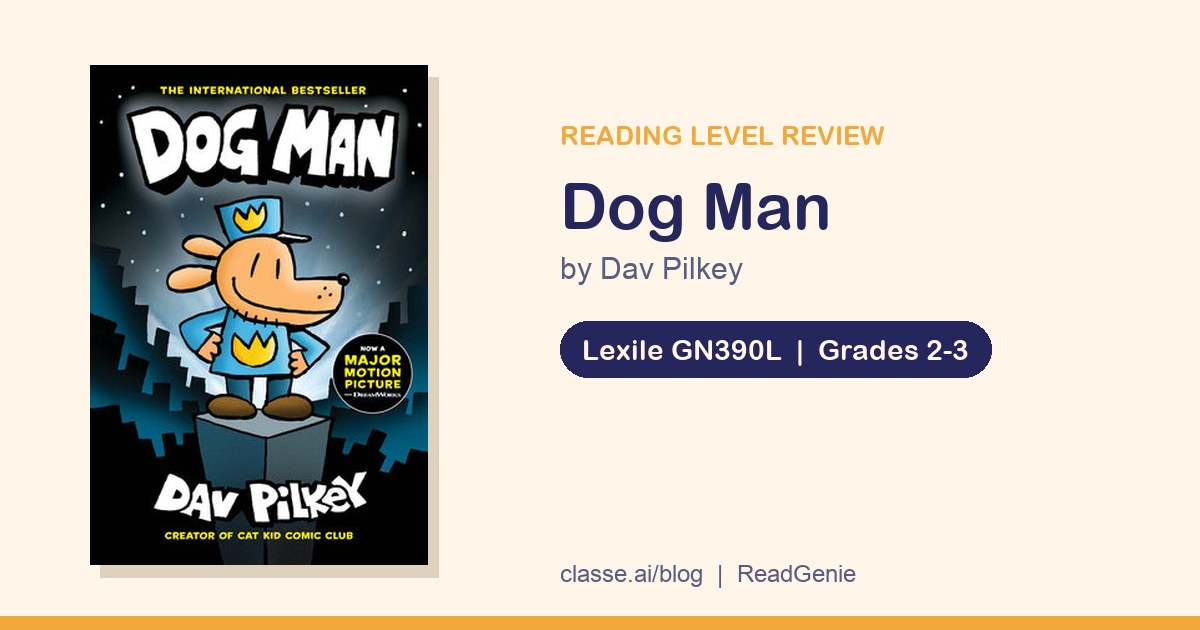
Dog Man by Dav Pilkey has a Lexile measure of GN390L, an AR (ATOS) book level of 2.6 and a Guided Reading level of P. Most kids can read it on their own by the end of 2nd grade or in 3rd grade. For struggling and reluctant readers in grades 2 to 5 it's one of the best books you can hand them, because the pictures carry much of the story and the words come in short speech bubbles. A child still reading at early levels will need you to share it, and the all-capital hand lettering slows down some dyslexic readers.
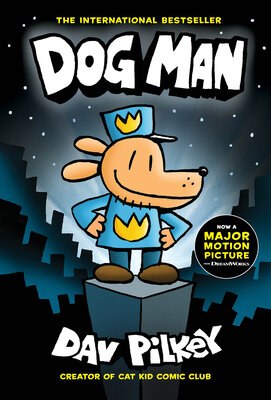
The setup is pure Pilkey. A police officer and his dog get hurt on the job, the doctors sew the dog's head onto the officer's body, and Dog Man is born. He's a great cop with one problem. He still acts like a dog, so he chases balls, rolls in things and naps at the worst moments. His enemy is Petey, an evil cat with big plans for the city. The whole book is presented as a comic made by George and Harold, the two boys from Captain Underpants, which is why it looks hand drawn and why a few words are spelled the way an 8-year-old would spell them. Kids read it, reread it and then beg for the next one.
Dog Man reading level at a glance
| Lexile measure | GN390L (Scholastic Teacher Store) |
|---|---|
| ATOS / AR book level | 2.6 (TeachingBooks) |
| AR points | 1 (TeachingBooks) |
| Guided Reading (Fountas & Pinnell) | P (Scholastic Teacher Store) |
| DRA level | 34-38 (Scholastic Teacher Store) |
| Interest level | Grades 1-4 (TeachingBooks) Also listed as Grades 2-12 |
| Approximate grade band | Grades 2-3 (ages 7-9) ReadGenie |
| Length | 240 pages, ~5,035 words |
| Format | Graphic novel |
| Good for struggling readers? | ★★★★★ 5/5 |
| Dyslexia-friendly rating | ★★★★★ 4/5 |
We couldn't find a published grade level equivalent or Flesch score for this book.
Scores checked 2026-11-02. Different leveling systems don't always agree, so we show each published value with its source and mark our own estimates. Links to every source are under How we rate books.
Is your child working hard and still getting stuck on words?
ReadGenie helps struggling readers improve their reading, spelling and handwriting with Orton-Gillingham practice at home. Your child reads out loud, the app listens, and it helps with the exact sound they missed. Join today and we'll mail your child Dog Man for free.
Try ReadGenie and get your free bookStarts with a free 7-day trial. Book mailed after your first paid month. US only, one per family.
What grade level is Dog Man?
Dog Man reads at about a 2nd to 3rd grade level. An AR level of 2.6 means the text is about as hard as what a typical student reads in the middle of 2nd grade. It's worth 1 AR point, which tells you the word count is small even though the book is thick. There are about 5,000 words across 240 pages.
The GN in front of the Lexile measure stands for graphic novel. MetaMetrics adds it to warn that pictures do a lot of the work, so the number alone can make a comic look easier or harder than it feels. A Lexile around 390 usually lines up with 2nd grade.
Guided Reading level P and DRA 34 to 38 both point to the end of 2nd grade or the start of 3rd. If your child's teacher says they're reading at level M, N or O, Dog Man is a comfortable stretch, since the pictures help with any word they don't know. Below about level J, kids tend to read the pictures and skip the words.
Ages are where people disagree. Scholastic sells it for grades 2 to 12, and TeachingBooks says grades 1 to 4. In real life, first graders love having it read to them, 2nd and 3rd graders read it alone, and plenty of 5th graders still grab every new book. The later books in the series stay at about the same level, so a child can keep going without hitting a wall.
Is Dog Man good for struggling readers?
Yes. We give it 5 out of 5 for struggling readers, and it's rare for a book to earn that.
The biggest reason is how little text sits on each page. A panel might have one bubble with six words in it. A child who reads slowly still moves through a page quickly, so the book never feels like work. And because the book is thick, finishing it feels like a big deal. A 4th grader who has never finished a "real" book can finish this one in a weekend and feel proud of it.
Dog Man also has no age stigma. Kids from 1st grade to middle school read it, so an older child reading below grade level can carry it around without anyone teasing. That counts for a lot with kids who already feel behind.
There are a few things to watch. The jokes are often puns, and a child who takes words literally may miss them. A few words are misspelled on purpose, which is part of the joke but can confuse a child who is still learning spelling rules. And because the pictures are so strong, some kids follow the art and skim past the words. Ask your child to read a couple of pages out loud now and then, so you know the reading is really happening.
It fits best for reluctant readers in grades 2 to 5 who say books are boring, and for kids moving up from early readers who aren't ready for pages of plain text. It's a weaker fit for children still reading at very early levels and for families who don't enjoy potty jokes.
Is Dog Man good for kids with dyslexia?
Overall: ★★★★★ 4/5
| Factor | Score | Why |
|---|---|---|
| Sentence length | 4/5 | Speech bubbles hold short lines of dialogue and sound effects, with only a few longer narration boxes. |
| Vocabulary load | 4/5 | Mostly everyday words, plus a handful of longer ones like villain, invention and newspaper. |
| Decodability | 3/5 | Many simple words, but deliberate kid misspellings and puns mean a reader can't always trust the spelling. |
| Text density and layout | 3/5 | Lots of white space and few words per panel, but the hand lettering is mostly capitals, which is harder for some dyslexic readers. |
| Pictures that carry meaning | 5/5 | Full-color comic panels on every page show exactly what is happening. |
| Chapter length | 5/5 | Short chapters, each a few minutes of reading, broken up by Flip-O-Rama pages. |
| Engagement for reluctant readers | 5/5 | Fast, silly and action-packed, the kind of book reluctant readers ask for by name. |
| Audiobook / read-along support | 2/5 | We could not confirm a widely available audiobook of book 1. Learning Ally lists human-read audio for some Dog Man titles for members with a print disability. |
We give it 4 out of 5 on our dyslexia-friendly scale. Visual support, chapter length and engagement all score as high as they can. Every page is full-color panels that show exactly what's happening, so a child who stumbles on a word can usually work it out from the picture. Chapters are short, and the Flip-O-Rama pages in between give tired eyes a fun break.
The lettering is the main concern. Pilkey hand letters the bubbles mostly in capital letters, the way most comics are lettered. Capitals all look about the same height and shape, so words lose the ups and downs that help many readers recognize them. Some dyslexic kids don't mind at all. Others find it tiring after a few pages. If your child starts guessing at words they know in lowercase, the lettering may be the reason.
The joke spellings are the other issue. Because George and Harold supposedly made the comic, a few words are spelled wrong on purpose. For a child working hard to trust spelling patterns, that can be confusing. It helps to point them out and laugh about them, so your child knows the book is wrong and they aren't.
Audio support is weak for book 1. We couldn't confirm a widely available audiobook, which makes sense, since so much of the story is in the pictures. Learning Ally, a library for readers with dyslexia and other print disabilities, lists human-read audio for some Dog Man titles, so it's worth checking if your family has an account. Reading it aloud together works better anyway, with you and your child each taking characters.
Words and phonics patterns to practice first
Dog Man works well once your child is solid on closed syllables, digraphs and silent e. Most of the words in the bubbles are short and regular, so a little pattern work goes a long way.
- Closed syllables with short vowels, like dog, cat, bad, help, stop and jump.
- Digraphs sh, ch and th, as in fish, this, that, catch and crash.
- Silent e, as in time, made, bone, hide, smoke and save.
- R-controlled vowels in hurt, car, smart, nurse, bark and work.
- Vowel teams, as in good, need, mean, boom, team and toy. Sound effects like boom are a fun way to practice these.
- Compound words like hotdog, newspaper, something, everybody and doghouse. Have your child find the two small words inside.
The words to pre-teach are Petey, Chief, police, officer, villain, George, Harold, laugh, said and whatever. Chief is worth a minute, since the ie spelling is unusual and the word shows up a lot. Police and villain don't sound the way they look, and laugh and said are classic heart words. Learning the names once pays off on almost every page.
If your child still sounds out these patterns slowly, a few minutes of practice a day makes a big difference. ReadGenie listens as your child reads aloud and helps with the exact sound they missed, so the patterns in Dog Man start to feel automatic.
How to read Dog Man with your child
Start by showing your child how a comic page works. Read the panels left to right and top to bottom, and read the bubbles in each panel from top to bottom too. Kids who are new to comics sometimes jump around the page and lose the thread.
Practice the names before you open the book. Petey and Chief come up again and again, and George and Harold appear in the opening pages.
For the first chapter, take turns. You read one character's bubbles and your child reads another's. Doing silly voices is encouraged. It keeps the reading fun and quietly builds fluency, because your child has to read the words with expression.
When you hit a misspelled word, stop and laugh. Ask your child how it should be spelled. That turns a possible stumbling block into a quick spelling check.
After the book, let your child make their own comic. Even four panels with a few speech bubbles each is real reading and writing practice, and Dog Man fans almost always want to try it. If they ask for the next book, say yes. Reading lots of books at an easy level is exactly what builds speed and confidence.
Using Dog Man in the classroom or tutoring
For teachers, Dog Man fits a Guided Reading level P group, and each chapter makes a natural stopping point for one session. It's also a great way to teach how to read graphic novels, which many students have never been shown. Model reading a page panel by panel, then have students explain what the picture adds that the words don't say. Pair it with a comic-making activity where students write and draw a short story of their own.
For tutors, it's good connected text once closed syllables, digraphs and silent e are in place. Use the misspelled words as a spelling check. The student finds the mistake and writes the correct word, which shows whether the pattern has stuck. For fluency, reread one short chapter with voices for each character, then read the next one cold.
Content notes for parents
Dog Man is full of slapstick cartoon violence, with chases, crashes and explosions where nobody is really hurt. There's plenty of potty and gross-out humor. The opening hospital scene, where the officer and his dog are injured, is played for laughs. Petey is a villain who schemes to take over the city, but nothing is scary. There's no swearing and no romance. The series also leans into kindness and friendship more and more as it goes.
Should your child read it?
If your child is reading somewhere around 2nd or 3rd grade level, or is older and says they hate reading, hand them Dog Man today. It's one of the surest ways to get a reluctant reader to finish a whole book and ask for another. Kids still reading at very early levels should start with Hi! Fly Guy or Narwhal: Unicorn of the Sea and come back to Dog Man in a few months. When Dog Man starts to feel easy, The Bad Guys and Captain Underpants add more text without losing the laughs.
Make the next book easier
Short daily sessions of reading, spelling and handwriting practice, built with Orton-Gillingham teachers. It works alongside tutoring and school support. The first 7 days are free. Join today and we'll mail your child Dog Man for free.
Try ReadGenie and get your free bookStarts with a free 7-day trial. Book mailed after your first paid month. US only, one per family.
FAQ
What age is Dog Man for?
Dog Man is usually read alone by kids about 7 to 9 years old, in 2nd and 3rd grade. Younger kids love it as a read-aloud, and many 10- and 11-year-olds still read the series for fun. Scholastic lists it for grades 2 to 12 because its appeal is so wide.
What is the Lexile level of Dog Man book 1?
The first Dog Man book has a Lexile measure of GN390L. The GN means graphic novel, a note that pictures carry a lot of the meaning. Later books in the series stay at about the same Lexile.
What is the AR level of Dog Man?
Dog Man has an AR (ATOS) book level of 2.6 and is worth 1 AR point. That means the text is about as hard as what a typical student reads in the middle of 2nd grade.
What Fountas and Pinnell letter level is Dog Man?
Scholastic lists Dog Man at Guided Reading level P, which most schools expect around the end of 2nd grade or the start of 3rd. Its DRA level is 34 to 38.
Is Dog Man too easy for a 4th or 5th grader?
For a strong reader, Dog Man is easy reading, and that's fine as a fun book. For a 4th or 5th grader who struggles, it's often a perfect fit, because it reads at a comfortable level without looking like a little kid's book.
Do kids actually read the words in Dog Man?
Most do, but some lean on the pictures. Ask your child to read a page or two aloud now and then, and talk about what the characters said. If they can't tell you, slow down and read together for a while.
Get Dog Man free
ReadGenie helps struggling readers improve their reading, spelling and handwriting in short daily sessions at home. Join and we'll mail your child this book for free.
Claim your free bookStarts with a free 7-day trial. Book mailed after your first paid month. US only, one per family.
What to read next
- Hi! Fly Guy by Tedd Arnold (easier). A funny, picture-heavy early reader for kids not yet ready for a whole graphic novel.
- Narwhal: Unicorn of the Sea by Ben Clanton (easier). A gentle early graphic novel with very short chapters.
- Cat Kid Comic Club by Dav Pilkey (similar). The Dog Man spin-off, with the same art style and humor and a push to make your own comics.
- InvestiGators by John Patrick Green (similar). Another pun-filled graphic novel series about animal detectives.
- The Bad Guys by Aaron Blabey (harder). Short, very illustrated chapter books with big laughs, a good next step toward more text.
- The Adventures of Captain Underpants by Dav Pilkey (harder). George and Harold's own series, with more text between the comic sections.
Browse all of our reading-level book reviews.
How we rate books
Lexile, ATOS (Accelerated Reader), Guided Reading and DRA levels come from the companies that own them and from publishers. We link to where we found each one, and when a level isn't published we say so. Anything marked "ReadGenie estimate" is our own call, not an official level. Flesch scores come from a short public excerpt when the publisher offers one. The struggling-reader and dyslexia-friendly ratings are our judgment, based on eight things (sentence length, vocabulary, decodability, page layout, pictures, chapter length, how gripping the story is, and audiobook support). Treat them as a starting point. The right book is one your child can read with about 95% accuracy and wants to keep reading.
Sources
- Scholastic Teacher Store: Dog Man (Lexile, Guided Reading level, DRA level, ACR level, page count, ISBN, grades)
- TeachingBooks: Dog Man (ATOS, AR points, Lexile, word count, grades, Spanish edition)
- TeachingBooks: Dog Man book 2 (series Lexile and ATOS range)
- TeachingBooks: The Scarlet Shedder (series Lexile and ATOS range)
- Learning Ally: Dog Man Grime and Punishment (audio for print-disabled readers)