Captain Underpants Reading Level: 720L, AR 4.3, Guided Reading P
The Adventures of Captain Underpants is Lexile 720L, AR level 4.3 and Guided Reading level P, so most kids read it alone in 3rd or 4th grade. Here's what that means for a reluctant or dyslexic reader, and which words to practice first.

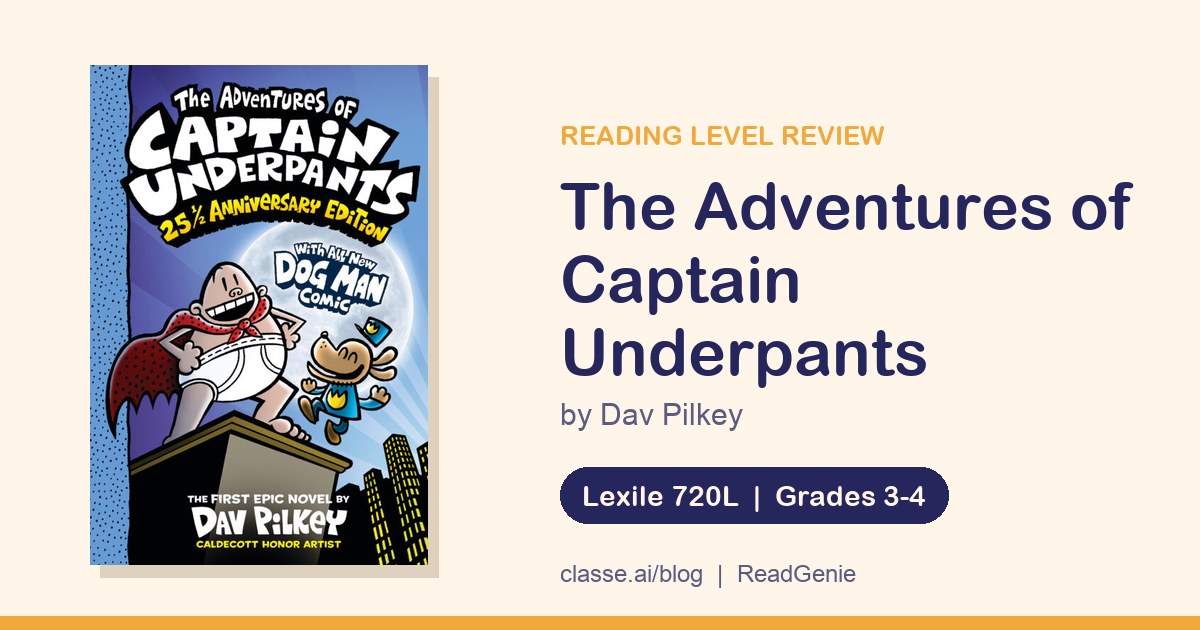
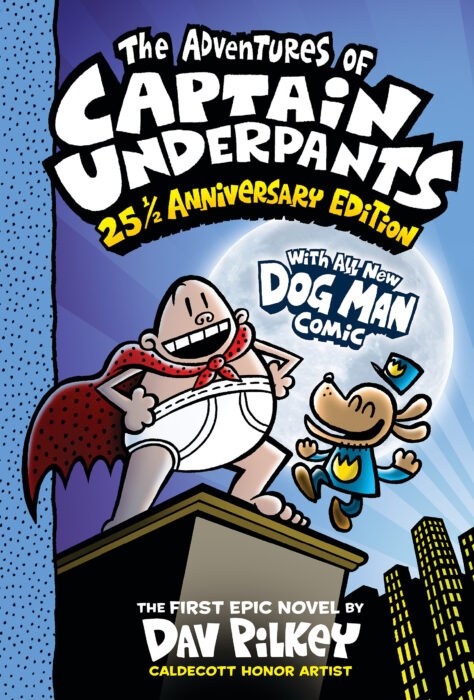
The Adventures of Captain Underpants by Dav Pilkey has a Lexile measure of 720L, an AR (ATOS) book level of 4.3 and a Guided Reading level of P. Most kids can read it on their own in 3rd or 4th grade. It's a strong pick for reluctant and struggling readers in grades 3 to 5, because the chapters are short, there's a drawing on almost every spread and the jokes keep kids turning pages. The comics inside the book are misspelled on purpose, so a child who is still learning to spell, or who has dyslexia, may need you to point that out.
George Beard and Harold Hutchins are two fourth graders with a silly streak a mile long. They run a comic book company out of a tree house, and their best hero is Captain Underpants, who fights crime in his underwear. When their grumpy principal, Mr. Krupp, catches them, the boys hypnotize him with a mail-order ring, and now he turns into Captain Underpants whenever someone snaps their fingers. Kids who know George and Harold from Dog Man are usually thrilled to find out where they came from.
The Adventures of Captain Underpants reading level at a glance
| Lexile measure | 720L (Scholastic Teacher Store) |
|---|---|
| ATOS / AR book level | 4.3 (TeachingBooks) |
| AR points | 1 (TeachingBooks) |
| Guided Reading (Fountas & Pinnell) | P (Scholastic Teacher Store) |
| DRA level | 34-38 (Scholastic Teacher Store) |
| Grade level equivalent | 3 (Booksource) |
| Flesch Reading Ease (0-100) | 75.4 ReadGenie estimate |
| Flesch-Kincaid grade | 5.9 ReadGenie estimate |
| Interest level | Grades 2-5 (Scholastic Teacher Store) Also listed as Grades 1-6 |
| Approximate grade band | Grades 3-4 (ages 8-10) ReadGenie |
| Length | 176 pages, ~5,731 words |
| Format | Chapter book |
| Good for struggling readers? | ★★★★★ 4/5 |
| Dyslexia-friendly rating | ★★★★★ 4/5 |
Scores checked 2026-11-11. Different leveling systems don't always agree, so we show each published value with its source and mark our own estimates. Links to every source are under How we rate books.
Is your child working hard and still getting stuck on words?
ReadGenie helps struggling readers improve their reading, spelling and handwriting with Orton-Gillingham practice at home. Your child reads out loud, the app listens, and it helps with the exact sound they missed. Join today and we'll mail your child The Adventures of Captain Underpants for free.
Try ReadGenie and get your free bookStarts with a free 7-day trial. Book mailed after your first paid month. US only, one per family.
What grade level is Captain Underpants?
Book 1 reads at about a 3rd to 4th grade level. An AR level of 4.3 means the text is about as hard as what a typical student reads early in 4th grade. It's worth only 1 AR point because the whole book is about 5,700 words, which is short for a chapter book with 176 pages.
A Lexile of 720L sits in the range most schools expect in 3rd and 4th grade. Guided Reading level P and DRA 34 to 38 point a little lower, to the end of 2nd grade or the start of 3rd. Booksource lists a grade level equivalent of 3. So the official numbers agree on a rough window. A child reading at level N or O can usually handle it with some help, and a child at P or Q should read it alone without trouble.
Why does the AR level look higher than the letter level? ATOS counts the long words and long sentences in the prose sections. Guided Reading levels also weigh how much the pictures and layout help, and this book has a lot of help on the page.
Our own count from the first two chapters gave a Flesch reading ease of 75, which is fairly easy text, with sentences averaging about 13 words. A few sentences are long lists of pranks and junk food, and those push formulas like Flesch-Kincaid higher than the book really feels.
The series gets a bit harder as it goes. Later books have somewhat higher Lexile and AR levels, and they get longer too. If book 1 is a comfortable read, the next few will stretch your child gently.
Is Captain Underpants good for struggling readers?
Yes. We give it 4 out of 5 for struggling readers.
The best thing about it is the pace. Chapters are often just four to eight pages, the type is large and paragraphs are short. A slow reader still gets through a chapter in one sitting, and that feeling of finishing is what keeps reluctant kids coming back. The pictures help too. In the color edition nearly every spread has a drawing, so a child can check what's happening when the words get hard.
It's also a book kids are proud to carry. Older kids still read it, and Dog Man fans already know the main characters. A 4th or 5th grader reading below grade level won't feel babied by it.
It isn't as easy as Dog Man, though. Dog Man is mostly speech bubbles. Captain Underpants has whole pages of regular prose between the comic sections. Some words are long for the level, like responsible, nonetheless and hypnotized. And the comics George and Harold "wrote" are full of spelling mistakes, which is the joke but can trip up a child who is just starting to trust spelling patterns.
It's a great fit for reluctant readers in grades 3 to 5, for kids moving from graphic novels to chapter books, and for anyone who likes drawing comics. Kids still reading below about level M will find the prose pages hard going. Start them with Dog Man or Ricky Ricotta's Mighty Robot.
Is Captain Underpants good for kids with dyslexia?
Overall: ★★★★★ 4/5
| Factor | Score | Why |
|---|---|---|
| Sentence length | 4/5 | Mostly short and medium sentences, about 13 words on average in our sample, with a few long lists. |
| Vocabulary load | 3/5 | Everyday words plus a handful of long ones (responsible, mayhem, nonetheless, hypnotized) and silly invented names. |
| Decodability | 3/5 | The prose is regular, but the comics inside the book are misspelled on purpose (dispare for despair), so readers can't trust every spelling. |
| Text density and layout | 4/5 | Large type, short paragraphs and lots of white space around the drawings. The comic pages use hand-lettered mixed capitals. |
| Pictures that carry meaning | 5/5 | Full-color drawings on almost every spread in the color edition, plus comic chapters that tell part of the story in pictures. |
| Chapter length | 5/5 | Many short chapters, often 4 to 8 pages each. |
| Engagement for reluctant readers | 5/5 | Fast, silly and full of pranks, a series kids ask for by name. |
| Audiobook / read-along support | 5/5 | Scholastic Audio published an unabridged audiobook in 2018, and public libraries lend it as an ebook-app audiobook. |
We give it 4 out of 5 on our dyslexia-friendly scale. Visual support, chapter length, engagement and audio all score as high as they can.
The layout is kind to tired eyes. Big type, short paragraphs and lots of space around the drawings mean a child never faces a wall of words. Chapters end often, which gives natural places to stop before frustration builds.
Decodability is where it loses points. The prose is regular, but the comics inside the book are hand-lettered in a mix of capitals and lowercase, and the spelling is wrong on purpose. A word like despair turns into a kid's guess at it. For most children that's funny. For a child with dyslexia who is working hard to learn that spelling follows rules, it can be confusing. Tell your child up front that George and Harold are bad spellers, and the mistakes become a game instead of a trap.
There's a real audiobook, which helps a lot. Scholastic Audio published an unabridged recording in 2018, and many public libraries lend it through their audiobook apps. Listening while following along in the print book lets a child enjoy the story at full speed while their eyes still see the words.
Words and phonics patterns to practice first
Captain Underpants is a good fit once your child is solid on closed syllables, digraphs and silent e, and is starting to handle r-controlled vowels and vowel teams.
- Closed syllables with short vowels, like best, kids, lot, next, class and pranks.
- Digraphs sh, ch and th, as in shop, much, chance, that, them and both.
- Silent e, as in nice, made, came, crate and joke.
- R-controlled vowels in hard, fourth, for, short, after and paper.
- Vowel teams like oo and ea, as in cool, school, food, each and streak.
- Compound words like backyard, playground, afternoons, everybody, superhero and underwear. Ask your child to find the two smaller words.
The words to pre-teach are George, Harold, Hutchins, Krupp, Jerome Horwitz, responsible, secretary, cupboard, mayhem, nonetheless and hypnotized. The names come up on almost every page, so learning them once saves a lot of stumbling. Cupboard and secretary don't sound the way they look, and nonetheless is three small words stuck together, which makes it a nice one to break apart.
If your child still sounds out these patterns slowly, short daily practice helps. ReadGenie listens as your child reads aloud and helps with the exact sound they missed, so words like these start to come faster.
How to read Captain Underpants with your child
Read chapter 1 together. It's only a few pages, and it introduces George and Harold in a way that makes most kids want to keep going. Before you start, practice the names so they don't slow down the first page.
When you reach the first comic, stop and say it out loud. These boys can't spell, and that's part of the joke. Then let your child hunt for the mistakes. Kids love catching grown-up-looking text being wrong.
Plan on about a week, two or three short chapters a night. The Flip-O-Rama pages near the end are a great reward. Let your child flip them while you do the sound effects.
On busy nights, play the audiobook and have your child follow along in the book. That keeps the story moving without turning reading into a chore. After you finish, ask your child to make their own hero comic. Even a few panels count as real reading and writing practice.
Using Captain Underpants in the classroom or tutoring
For teachers, it fits a Guided Reading level P group in 3rd or 4th grade, and it's a good choice for students who say they don't like to read. The narrator talks straight to the reader, which makes a fun mini lesson on point of view. Students can write their own short comic, then compare their spelling with George and Harold's.
For tutors, the first two chapters are good connected text for compound words and r-controlled vowels. Turn the comics into spelling practice. The student reads a misspelled line aloud, finds the mistake and writes the word correctly. That shows quickly which patterns have stuck.
Content notes for parents
The whole series runs on potty and underwear humor. George and Harold play pranks on their teachers and hypnotize their principal, and the book doesn't stop to teach a lesson about it. There are cartoon fights with a villain named Dr. Diaper and his robots, with nobody really hurt. There's no swearing and no romance. Some families love the silliness and some don't, so a quick flip through the book will tell you which camp you're in.
Should your child read it?
If your child reads around a 3rd or 4th grade level, or is older and says reading is boring, Captain Underpants is a great next book. It's the natural step up for a Dog Man fan who is ready for more text on the page. Kids still reading at early levels should start with Dog Man or Ricky Ricotta's Mighty Robot. When Captain Underpants feels easy, Sideways Stories from Wayside School and Diary of a Wimpy Kid are good next reads.
Make the next book easier
Short daily sessions of reading, spelling and handwriting practice, built with Orton-Gillingham teachers. It works alongside tutoring and school support. The first 7 days are free. Join today and we'll mail your child The Adventures of Captain Underpants for free.
Try ReadGenie and get your free bookStarts with a free 7-day trial. Book mailed after your first paid month. US only, one per family.
FAQ
What reading level is Captain Underpants?
The Adventures of Captain Underpants has a Lexile of 720L, an AR level of 4.3, Guided Reading level P and DRA 34 to 38. Most kids read it on their own in 3rd or 4th grade.
What is the Captain Underpants Lexile level?
Book 1 is 720L. Later books in the series run a little higher, so the series climbs slowly as your child reads on.
What is the Captain Underpants AR level?
Book 1 has an AR book level of 4.3 and is worth 1 AR point. Later books are a little harder and longer, so they earn more points.
What age group is Captain Underpants for?
Most kids read it alone at about 8 to 10. Scholastic sells it for grades 2 to 5, and many older kids still read the series for fun.
Is Captain Underpants harder than Dog Man?
Yes. Dog Man is mostly short speech bubbles at about a 2nd grade level. Captain Underpants has full pages of prose and reads closer to 3rd or 4th grade, so it's a good next step.
Why are the comics in Captain Underpants spelled wrong?
The comics are supposed to be written by George and Harold, two fourth graders who aren't great spellers. It's a joke, but point it out early so your child doesn't copy the spellings.
Get The Adventures of Captain Underpants free
ReadGenie helps struggling readers improve their reading, spelling and handwriting in short daily sessions at home. Join and we'll mail your child this book for free.
Claim your free bookStarts with a free 7-day trial. Book mailed after your first paid month. US only, one per family.
What to read next
- Dog Man by Dav Pilkey (easier). George and Harold's comic about a part-dog police officer. Mostly speech bubbles, so a gentler start.
- Ricky Ricotta's Mighty Robot by Dav Pilkey (easier). A shorter Pilkey chapter book with a robot hero and Flip-O-Rama pages.
- The Bad Guys by Aaron Blabey (easier). Heavily illustrated, very funny chapter books about villains trying to be heroes.
- Big Nate: In a Class by Himself by Lincoln Peirce (similar). A sixth-grade troublemaker and comics mixed into the story.
- Sideways Stories from Wayside School by Louis Sachar (harder). Short, silly school chapters with no comics, a good next step.
- Diary of a Wimpy Kid by Jeff Kinney (harder). Cartoon-filled diary of a middle schooler with more text per page.
Browse all of our reading-level book reviews.
How we rate books
Lexile, ATOS (Accelerated Reader), Guided Reading and DRA levels come from the companies that own them and from publishers. We link to where we found each one, and when a level isn't published we say so. Anything marked "ReadGenie estimate" is our own call, not an official level. Flesch scores come from a short public excerpt when the publisher offers one. The struggling-reader and dyslexia-friendly ratings are our judgment, based on eight things (sentence length, vocabulary, decodability, page layout, pictures, chapter length, how gripping the story is, and audiobook support). Treat them as a starting point. The right book is one your child can read with about 95% accuracy and wants to keep reading.
Sources
- Scholastic Teacher Store: The Adventures of Captain Underpants (Lexile, Guided Reading level, DRA level, page count, ISBN, grades, excerpt (See Inside))
- TeachingBooks: The Adventures of Captain Underpants (ATOS, AR points, Lexile, word count, grades, Spanish edition)
- Booksource: The Adventures of Captain Underpants (Color Edition) (Grade Level Equivalent, Guided Reading level, AR level, interest level)
- TeachingBooks: Captain Underpants and the Preposterous Plight of the Purple Potty People (series Lexile and ATOS range)
- TeachingBooks: Captain Underpants and the Terrifying Return of Tippy Tinkletrousers (series Lexile and ATOS range)
- TeachingBooks: Captain Underpants and the Sensational Saga of Sir Stinks-A-Lot (series Lexile and ATOS range)
- Spokane Public Library: The Adventures of Captain Underpants audiobook (audiobook)